You could say there are three categories in which non-musicians can write about music: music journalism, music criticism, and music essays. Something I’ve learned in my years as a consumer and producer of music writing is that its level of value depends largely on who the reader is. In general, journalism and criticism are most useful to neophytes unfamiliar with the given musical subject, who are just getting into a band or wondering if a new release is worth a listen. Articles and reviews serve as invaluable touchstones for all of us to become fans – but once you’re a seasoned devotee of whatever artist or genre, you reach a point where you know just as much or probably more than the average music hack. You can nitpick their ignorant misstatements about a band’s lineup and discography, or rail against their clueless ★½ rating of a brilliant album. At this stage, a matured fan can largely cast aside journalism and criticism like old training wheels.
On the other hand, personal music essays have the exact inverse relationship with the audience. If you want to write about what a given performer’s music means to you and detail your experiences as a fan, you pretty much need to assume your readers share in that fandom. Stories about that band’s first concert you saw, or fond high-school summer memories from when that big song was popular, or hunting down that elusive import 12” holy grail may make delightful reading for those who can relate, but they’re more likely boring and self-indulgent in the eyes of the uninitiated. And sure, music essays can be just bad, period. But when they’re good, they’re a marvelous way to partly capture the ineffable joys of music in written words, to connect new insights and moments of recognition among your far-flung brothers and sisters of similar dispositions.
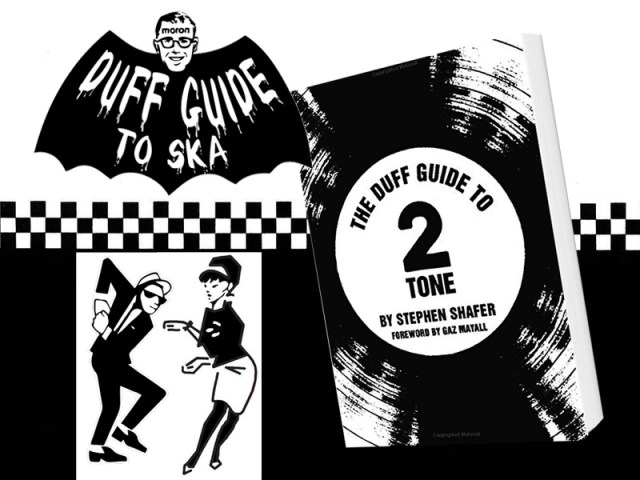
In his new book, The Duff Guide to 2 Tone, Stephen Shafer deftly does all three kinds of music writing: journalism, criticism and essays, all swirled together to a brisk skanking rhythm. The book largely consists of reviews and articles culled from Steve’s popular blog, The Duff Guide to Ska, which has covered ska and ska-related music since 2008. Being from New York, Steve shares a mission in common with us at Stateside Madness: appreciating music of Jamaican and British origins from an American point of view. The Duff Guide has been something of a role model for me in developing the SSM blog, so it’s been an honor for Steve to find us and give us a number of kind shoutouts in our first year on the scene.
The Duff Guide to 2 Tone is organized into sections covering the primary acts with singles and/or albums released on Jerry Dammers’ legendary 2 Tone Records: The Specials, Madness, The Selecter, The (English) Beat, Rico Rodriguez, The Bodysnatchers and Bad Manners, and a few choice “2 Tone adjacent” artists at the end. The result is one of those nice, sumptuous compendiums that you can flip through and read swatches of interest in whatever order you like. That’s an experience you can’t replicate by clicking links in a blog, giving me flashbacks to hours spent with my beloved Trouser Press Record Guide – only here in an all-ska all-stars edition.
The Madness section covers the band’s output from 2009 to 2019 quite comprehensively, including the Lee Thompson Ska Orchestra, “Bullingdon Boys” and the Before We Was We book. Steve gives a fine accounting of what Madness has been up to over the past decade, but like I said before, I really don’t need someone to tell me how good they think Oui Oui Si Si Ja Ja Da Da and Can’t Touch Us Now are. What I like reading most is Steve’s personal asides.
Though it may seem anathema for someone with my obvious bias, I found myself especially enchanted with Steve’s confession that he was never the hugest fan of Madness. In his ranking of the top 2 Tone acts back in the day, Madness came in at number four, with The Specials/The Special AKA being his big favorite. He explains that he was drawn to the strong political views expressed by the Dammers crew from Coventry (as well as The Beat and The Selecter), moreso than the comparatively sunny pop sensibilities of the Nutty Boys. That’s fair enough, an opinion shared by many of my friends who have showed appreciation for British ska. Americans tend to deem The Specials the “coolest” band in the genre, I know. But when The Liberty of Norton Folgate came along in 2009, Steve had to reconsider his former assessment.
“When it seemed like their 2 Tone peers had run out of things to say,” he writes, “Madness were delivering the songs of great meaning that I had wanted from them in my youth – a concept album that promotes multiculturalism as the only path to real freedom, and the notion that the history of a place and its people has an extraordinary impact on making this possible.” This he follows with a thorough unpacking of “We Are London” and the epic title track, dissecting them with rigorous wonder. It’s some of the finest Madness analysis I’ve ever read.
The Duff Guide to 2 Tone is chock full of personal fan nuggets that elevate it above a mere collection of record reviews. I relish Steve’s finding of the exceptionally rare Rico Jama LP. I envy him for seeing Pauline Black and Rhoda Dakar play together in New York City in 2019. I admire his heartfelt reflections on the occasion of Ranking Roger’s passing. I relate to his interview with Roddy “Radiation” Byers, whom I myself had the pleasure of chatting with at length before a North Carolina gig a couple of years ago. I love that Steve mentions his favorite album by The Beat is Wha’ppen? No way, I think he and I must be the only two fans who share that oddball opinion! And indeed, his reviews have a thing or two to teach a crotchety old know-it-all like me – for instance, I had vaguely heard of The Specials’ Live at the Moonlight Club but never bought it. After reading Steve’s reverential praise for the 1979 bootleg-turned-legit release, I had to go grab it. I’m sure glad I did. Thanks, buddy.
If I had to criticize one thing about The Duff Guide to 2 Tone, it would be the editorial presentation. The professional copy editor in me wishes I could have taken a pass at assembling the manuscript in a more orderly fashion. The reviews are largely in reverse chronological order for whatever reason, with miscellaneous essay and interview pieces coming at the end of each section. I would have arranged things more strictly from oldest to newest. I also would like to see a brief intro at the start of each new section profiling the given artist by listing their 2 Tone bona fides and outlining their career up to the point in 2008 when The Duff Guide blog began, just as orientation for newbies. Doing so wouldn’t require a lot of new writing. Prime example, the first review in The Bodysnatchers section starts with about three pages on their background, making a really excellent capsule recap of Rhoda Dakar’s body of work. You could just lift it out and have a nice Bodysnatchers preamble ready to go.
But I’m probably just being too finicky and pedantic in my publishing ethos. A book as niche as The Duff Guide to 2 Tone is best aimed at full-fledged fans, those who already know their Price Buster from their Buster Bloodvessel – and any interested novice worth their salt will accept a good challenge above their reading level. No doubt, Steve Shafer scores high marks as a music journalist, critic and essayist. I’m more focused in my own ambitions here at Stateside Madness, favoring the “let me tell you my story” essay end of the spectrum, and in that capacity I’m proud to have Steve as a virtual mentor of sorts and comrade-at-arms. Here’s to hoping we can meet up for a super-nerdy fanboy conversation at a ska concert some fine day.
As a kid in the ’70s, I always hated American Bandstand. Not so much because of the music or Dick Clark, but because every week it marked the dreaded end of Saturday morning cartoons. After the final Schoolhouse Rock lesson of the day, when you heard Barry Manilow crooning about goin’ hoppin’ today, where things are poppin’ (pop) the Philadelphia way, you knew it was over. Time to switch off the TV and scrounge up something else to do. American Bandstand was for dumb teenagers like my sister, with their inscrutable critical judgment of whether the new K.C. & The Sunshine Band single had a good beat that you could dance to.
Aging into that demographic in the ’80s, I began to tune into the Bandstand now and again, especially when prompted by TV Guide that bands I liked were going to be on. I recall seeing favorites like Men at Work, the Go-Go’s, Big Country, General Public, Katrina and the Waves… and Madness.
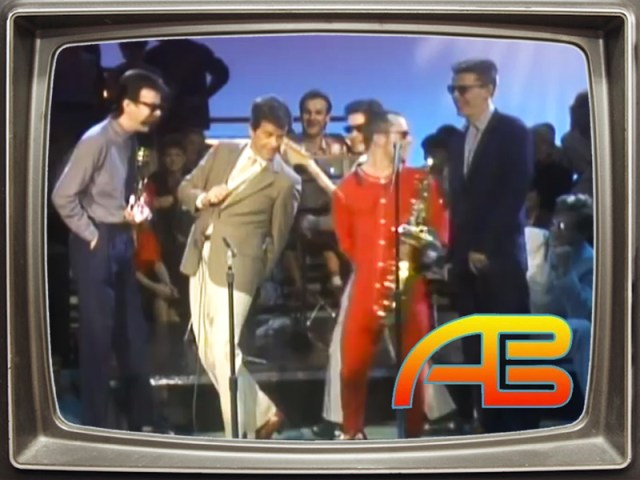
When the boys turned up on America’s closest equivalent to Top of the Pops on March 3, 1984, it was a major event for me. They played (or more accurately, mimed) their current U.S. single “The Sun and the Rain” as well as “Keep Moving,” title track from the just-released album. I was head-over-heels in love with the U.S. Keep Moving album, and seeing Madness promote it on American Bandstand served to validate my loyalty to the band as more than a one-hit wonder.
Presumably because of copyright enforcement, Bandstand performances are hard to find on YouTube. But there is a video clip from Dick Clark’s 1984 interview with Madness, and it’s a right corker.
Analyzing this historical document, I first note how Dick addresses our dear frontman as Suggs McPherson (mispronounced like Elle McFEARson, to boot). This is what I always called him for many years: first name Suggs, last name McPherson. It wasn’t until his The Lone Ranger album in 1995 that I grokked that Suggs is properly a mononym. Tacking on his surname is like saying Cher Sarkisian or Bono Hewson. At the start and end of the interview you can spot Suggs doing his patented askew “glasses funny,” a stage move he repeated ad nauseam during the ’90s reunion era. How odd it is to hear him say “We’ve known each other for about six years.” Man, I’m wearing socks older than that.
Asking about the band’s notorious rendition of “God Save the Queen” on kazoos at the 1982 Prince Charles Trust Concert, Dick Clark randomly sticks his microphone in the face of the mustachioed trumpet player, and also his namesake, Dick Cuthell. Of course Cuthell wasn’t part of that royal command performance two years prior, but he gamely replies, “I didn’t have a kazoo at the time.”
At this point the interview is rudely thrown into disarray by the unruly Lee Thompson. Clad in red longjohns, sunglasses and fingerless gloves festooned with M logos, Lee circles around Dick Clark like a jaguar stalking its prey, feigning a Benny Hill grab-and-miss at Clark’s backside. Thommo settles down for a moment before going in for a second pass, and this time he hits the target, majorly. Although the camera is on Dick Cuthell at the moment of assault, as it were, it’s safe to say our Lee Jay Thompson indecently groped a beloved showbiz icon on national television.
“Have you no respect?” Clark bellows in mock outrage, over whoops and hollers from the underage eyewitnesses. I’ve read some tabloidy accounts of the Kix-Dick-Goose incident claiming that Clark was infuriated and cursed out the band afterwards, but that’s pretty clearly nonsense. Harmless fun was had by all, and Dick warmly thanks the band like they’re friendly old acquaintances.
Which, in fact, they were.
At the tail end of the interview clip you can hear Dick say, “We’re delighted to have you back.” I did not realize until just recently that Madness first appeared on American Bandstand back in 1980! What, are you kidding me?
Yes, four years earlier, on April 19, 1980, our very young Nutty Boys capped off their second U.S. tour with an unlikely slot on the Bandstand. This was surely Madness’s American television debut, and I’m equally certain I didn’t see it broadcast. Their lipsynched performances of “One Step Beyond” and “Madness” are not to be found on YouTube, but once again the interview segment is.
You’ll catch that right off the bat, Lee pinches Dick Clark’s inner thigh – so clearly the man’s ageless derrière was an object of long-term enticement for Mr. Thompson. After that, Lee walks off camera and behaves himself for the remainder of the proceedings, leaving Mike and Carl to be the big cutups this time. As Dick questions Suggs about ska music, Barso angles for attention in the background with a bonkers “turkey neck” move. Carl mugs for the camera, joins Mike in a brief turkey mating ritual, then busts out some trademark nutty dance moves. Chrissy Boy and Bedders swing their guitar necks (in lieu of their own) and impishly prance about to dial up the pandemonium, while Woody and Lee mind their own business. And all this went down on ABC television in the year 1980. Unreal.
I just can’t imagine how Madness got booked on American Bandstand back then. No hit songs, utterly unknown except in hip New York/California circles where they had toured and got minor college radio exposure. Sire Records must have had a superhumanly persuasive booking agent, or else the Bandstand had to scramble to fill a last minute cancellation by Sister Sledge. I would dearly love to see how the unsuspecting crowd of dancers reacted to Chas Smash shouting out “Hey you! Don’t watch that, watch this!” I’d almost wager the show’s producers made them skip the intro and launch right into the song, lest the teenyboppers awkwardly stand by waiting for a good beat to dance to. What a strange little chapter in the band’s primordial history.
It actually upends my personal narrative as a Madness fan, a bit. I’ve always believed and maintained that I didn’t get on the nutty train until “Our House” was a hit in 1983 because I never had an opportunity to be exposed to Madness before that. But no. That’s all a lie now. I could have seen them on freaking Dick Clark’s American Bandstand back in 1980! Dang it, what a near miss and epic fail!
You can’t excuse me for having been too young or too unsophisticated in taste, either. In January 1980, I saw the B-52s play “Rock Lobster” on Saturday Night Live and became an instant fan at the tender age of 10, nearly a decade before “Love Shack.” I was into weird and crazy music as a kid, and if I’d seen Madness on TV at that juncture, I doubtless would have been set on my eventual path of musical appreciation much earlier in life.
What if, on that one pivotal Saturday afternoon, I had watched American Bandstand with my sister instead of going out to play with Star Wars figures? What if I had heard “One Step Beyond” and seen these hooligans clowning around with Dick Clark, talking about something mysterious called ska? What if them rockin’ on AB had led me straight to “Rockin’ in Ab”? What if I’d got my hands on The Rise and Fall right after its UK release, and “Our House” was already an old favorite by the time U.S. radio got clued in?
What an interesting alternate history some precocious parallel universe me got to enjoy, madly accelerated. Still, I’m happy enough with the way things played out. On a scale of 35 to 98, I rate it at least a 75.
The music of Madness has served as soundtracks and jingles in quite a lot of American TV commercials. We fondly recall the vintage kids’ Colgate Pump ad, imported from the UK, which surely got more airplay here than “Baggy Trousers” itself. (Anyone up for a sequel, “The Liberty of Brushin’ Colgate”?) Levi’s borrowed “It Must Be Love” for a baffling pantomime of romantic devotion between a guy and his best… jeans? And of course “Our House” has done its share of flogging U.S. brands, from a clever “Jingle Bells” mashup for Verizon to a severely not-clever bastardization for Maxwell House.
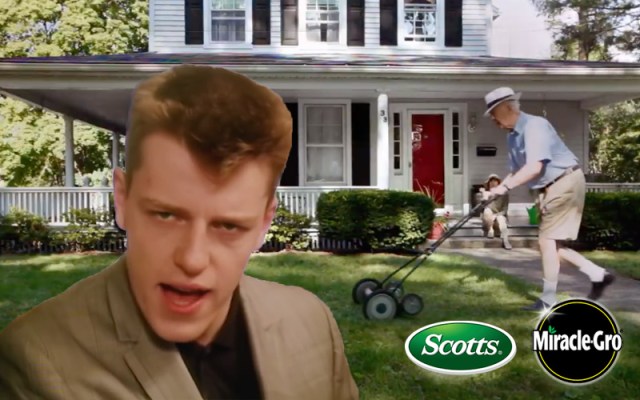
Now there’s a new “Our House” ad for Scotts Miracle-Gro that’s as surprising as it is timely. And it really does our band (house) proud. Take a look.
Created by New York agency VaynerMedia, the spot plays to our shared need for summertime fun during a global pandemic lockdown. The scenes of staycation festivities consist of real people, shot in backyards on their phones and cameras – “user generated content,” as they say in the marketing biz. Scotts Miracle-Gro ads usually focus on gardening and landscaping, but the current situation inspired the company to think in broader terms of what our lawns mean to Americans. They’re not just the grass and trees outside, they are valued as part of “our house,” and a safe haven where we make memories.
For Madness fans, what’s really significant about the ad is the version of the song used. It’s not the original hit single, and it’s not a cover version. It’s Madness themselves, putting a more contemplative spin on “Our House” from 2013. It’s known as The People’s Palace Version, recorded outside North London’s beloved Alexandra Palace with a chorus of fans as a gesture of thanks and appreciation to the band’s loyal supporters.
That Ally Pally recording has always given me goosebumps, stirring my emotional connection to my Madhead brothers and sisters. Look, there’s a woman wearing the same Madstock 2009 shirt I cherish from my first Madness show. I am one of them. This is my tribe. The only one thing I don’t love about this anthemic singalong is that it doesn’t include the whole of “Our House.” And I tell you, I never in a million years would have guessed it would end up being broadcast in an American commercial.
Consider this: Other than the odd appearance on a U.S. talk show, or high-profile special events like the Olympics or an NFL game in London, this amounts to the first time a post-1980s Madness recording has been granted a mass American audience! Surely some ad creative at VaynerMedia must be a legit Madness fan, because I can’t imagine the People’s Palace “Our House” is well documented in Madison Avenue music licensing libraries.
Kudos to whoever made that call, because the ad works brilliantly. It doesn’t matter if the majority of viewers don’t realize that’s Madness, the original artist, judging by the online comments about that melancholy “cover.” Even if Suggs’ matured and mellowed voice carries zero recognition or nostalgia factor, look at all the universal buttons being surgically punched. Father, mother, sister, brother, the kids are playing. British Madness fan voices transfigured into a surrogate choir of American families. Abundant summer fun without the beach or the highways or the Disneyland. Right in our own backyards, there’s always something happening and it’s usually quite loud. We remember way back then when everything was true and when we would have such a very good time, such a fine time. Such a happy time.
Which is exactly what we all need once again, right now.
Beyond Madness, my second favorite British act of all time is Paul Weller. Relations have been friendly and collegial among them over the decades, dating back to Weller citing “Embarrassment” as an inspiration for the Motown beat of The Jam’s “Town Called Malice.” Of particular note, while working as an early ’90s A&R rep at Go! Discs, Carl Smyth helped Weller launch his solo career. In the past year, Weller joined Madness on stage at House of Common 2019 to great acclaim, and he guested on Suggs’s Love Letters to London BBC Radio 4 series, which saw the pair of them duetting on “Nobody’s Fool” by Ray Davies.
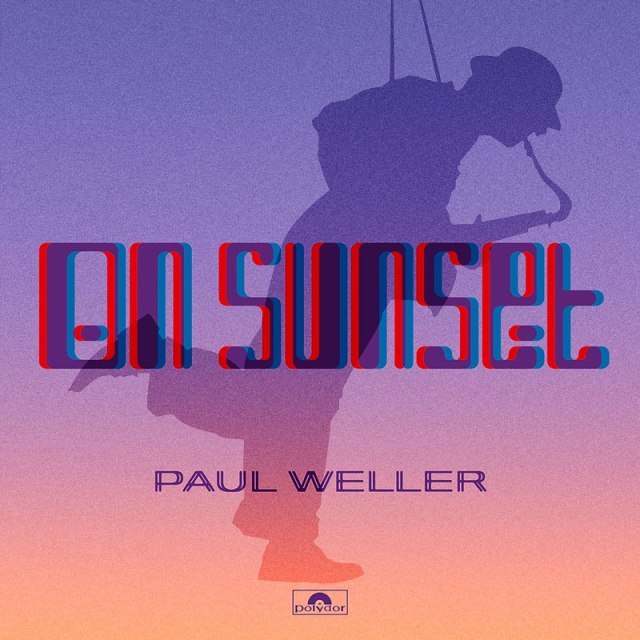
And now Lee Thompson has turned in a guest spot on Weller’s high-profile new album. On Sunset went straight in at #1 in the UK, giving Weller the accomplishment of topping the album chart in five consecutive decades, a feat matched only by Lennon and McCartney. There’s no American angle in reporting this Weller and Thompson collaboration (safe to say On Sunset isn’t making history in the U.S. charts), but when anyone from Madness teams up with one of my other musical heroes, you better believe Stateside Madness will have something to say about it!
Thommo contributes a laid-back sax solo on the Weller-penned track “Walkin’.” Paul has been enthusiastic in his praise for Lee’s work. “I’ve seen Lee playing blinders in recent years, both with Madness and with his Ska Orchestra. He’s a terrific player.”
Have a listen to “Walkin’” (Lee comes in around 1:38.)
So what do I think? Honestly, it’s a bit disappointing. The song isn’t the most interesting on the album, and it sounds a lot like a reworking of “Here’s the Good News” from 2005’s As Is Now (which wasn’t one of the most interesting on that album, either). Probably unfairly, I had imagined this would amount to something more like Lee’s brilliant guest sax on The Specials’ “Hey, Little Rich Girl,” where it’s 100% that inimitable Lee Jay Kix Thompson sound, whereas the “Walkin’” solo could be any decent session player.
I believe my reaction to On Sunset has suffered from too much anticipation and advance buildup. This is also the case with the 7-minute opening track “Mirror Ball,” which has been hyped as an epic creative watershed in every Weller article and interview for the past year, but hits me – as much as it pains me to say – as a boring swing and a miss. (Apologies, Paul.)
But new songs do often need to grow on you, and I will say that I’m warming up to “Walkin’” the more I listen to it. It’s no masterpiece, but it’s a nice, breezy, easygoing summer tune. I’m happy Lee Thompson played on it. This partnership between Weller and Thommo gives me hope that someday I’ll get my fantasy wish of hearing Paul belt out a cover of a certain old Madness tune he rated back in the day. That one what Lee wrote.
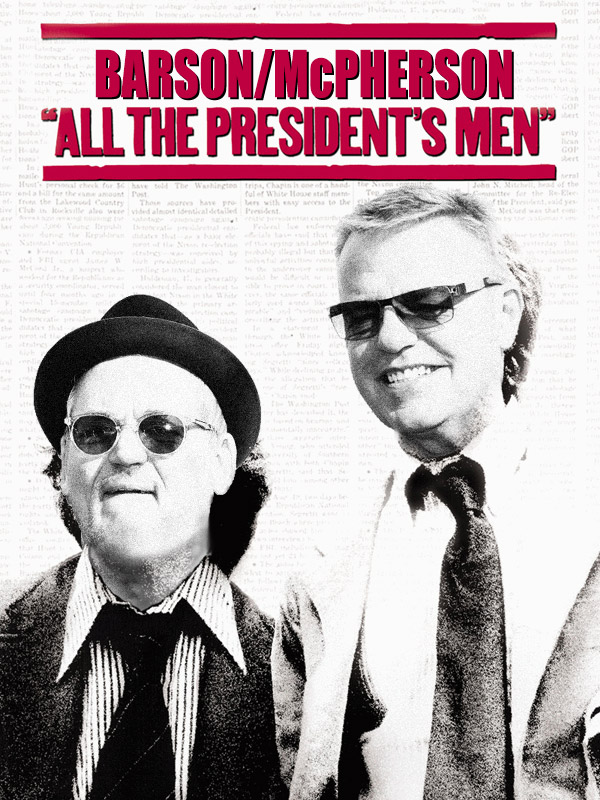
In the course of their intimate Two Mad Men and a String Quartet performance shared online June 6, Suggs and Mike Barson debuted two new Madness songs. “Theatre of the Absurd,” a Suggs composition, appears to be a spiritual sequel to his solo track “The Greatest Show on Earth” with a more somber tone. The other new tune is of particular interest to us at Stateside Madness, for reasons Barso outlined in his introduction:
“This song is about the dire straits over the pond at the moment. No, not really at the moment. It’s a song about our cousins in America, yeah. Leaders of the world. And where they’re leading us, who knows?”
Running just over 90 seconds, “All the President’s Men” is a terse meditation on social and political turmoil in recent U.S. history, mourning the current tattered state of the American dream. Barson borrows the title from the Woodward & Bernstein exposé on Watergate (and the subsequent Redford & Hoffman film adaptation), which originated as an allusion the irreparable injury following Humpty Dumpty’s fall.
The song is bracingly relevant in the context of international protests in response to the death of George Floyd. The mood and message beautifully fit the string quartet format, and an eventual studio recording could likely prove to have a similar sparse arrangement. A fantastic new piece of work to suit our troubled times.
The year was 1963 The last one for Kennedy In ’68 the Lorraine Motel On the balcony Where the Doctor fell From a single shell
A last shot at democracy Shining city on a hill Land of the free Seventeen agencies Looking out for thee The NSA and Homeland Security
A shot rang out The sound of gunfire echoes ’cross the mall The future sucked into a dark black hole Short-sighted small minds clamour for control
But there’s no dream no more Psyops are now running the score And the money trickles upwards evermore You’d almost think it was 1984
American Madness fans have always got the short end of the stick. Sporadic tours, loads of music unreleased on U.S. labels, and our general suffering from the band’s local reputation as a novelty ’80s one-hit wonder. But there is one notable category in which only the U.S. (and Canada) got the very best version of Madness. Because the North American edition of the 1984 Keep Moving album is infinitely superior to the original British release in every possible way. Fight me.
But before we step into the bloody ska-octagon to duke it out, let me rewind. Prior to Keep Moving’s appearance, “Our House” had made me a Madness fan, and I had tracked down the band’s domestic and imported back catalogue. In this interval I wondered what the future might hold for Madness. Would they go back to being an exclusively British phenomenon? I recall telling a friend my anxiety over possibly “losing” my new favorite band if they didn’t have more U.S. hits. “Do you think they’ll try again?” I asked with trepidation. At this point I would have had no idea of Mike Barson’s impending departure or the band’s internal tensions, but for some unfounded reason I feared there may not be a next Madness album.
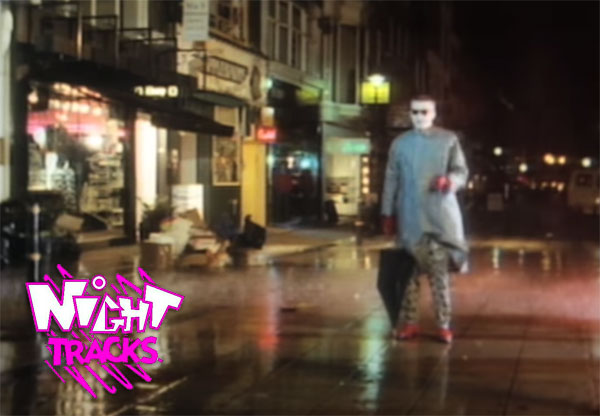
Then one Saturday night in early 1984, as I watched Night Tracks on SuperStation TBS, I caught an unfamiliar piano melody being pounded out by an absurdly long-armed fellow. The piano spontaneously exploded, a distinctive rhythm section joined in, and my shocked brain sputtered “Wait, could this be Madness?” when Suggs McPherson himself appeared, singing in the rain with his sunglasses on. The music video credits gave me the lowdown:
MADNESS “The Sun and the Rain” Keep Moving Geffen Records
Whoa! An unexpected new Madness song! A new Madness video! And better yet, a whole new Madness album! Unreal! I was so overwhelmed with sensory bombardment that I could barely absorb the song. All that registered was lyrics about inclement weather, that killer Barson piano riff, and the band wearing red bodysuits inside a mockup of Suggsy’s hollow head. How thrilling to see proof that Madness was indeed trying America again. One might say they were resolved to keep moving.
The next morning I mentioned to my dad that Madness had a new album out and I was anxious to hunt for it. I figured we’d need to run to Camelot Music in Hendersonville, where I had bought the One Step Beyond / Absolutely double cassette. Daddy ended up running some errands on his own that day, and to my surprise he called home from Pretzel’s Records in nearby Canton. He said he’d found a Madness tape at the store and wanted to make sure it was the right one. Yep, Keep Moving! That phone call was an unusual gesture from my dad, so I must have made a major impression about desperately I wanted this Madness tape. Teenage whining pays off sometimes.
Oh, how delighted I was with Keep Moving! This was my first time getting a new Madness album upon its release, and it was spectacular. The one reservation I had at first was that the style of the vocals was now… different. Suggs had begun crooning, with a velvety tone all whispery and soft around the edges, compared to his cockney croak from early Madness. Carl got more honey-throated too, on “Michael Caine” and “Victoria Gardens.” Initially I thought their smoothed-out serenading sounded a tad posh and phony, but I soon accepted it as a natural consequence of maturity.
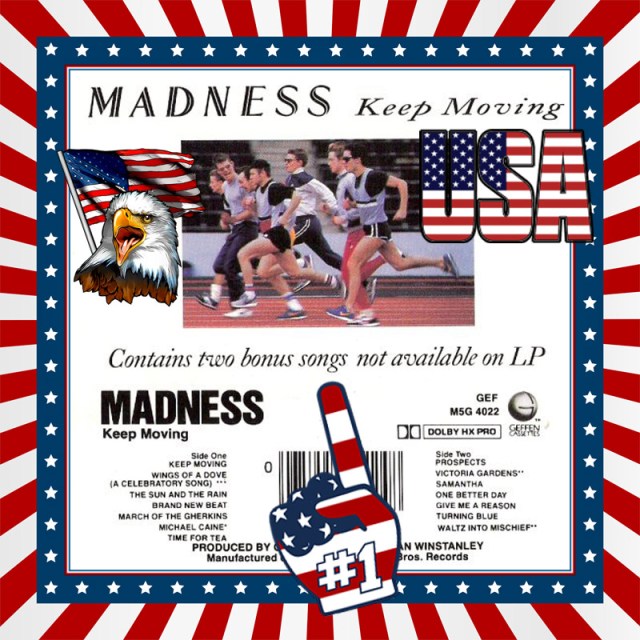
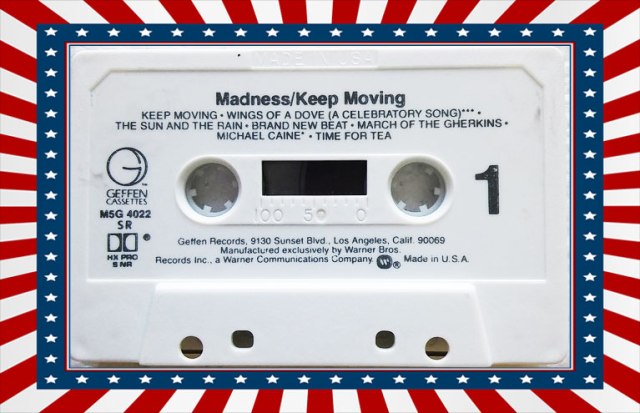
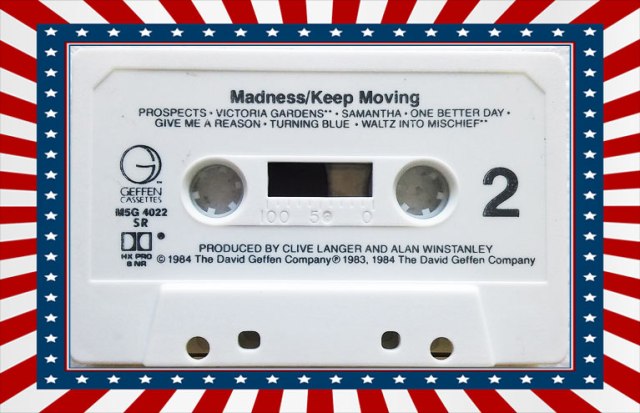
That’s really the defining character of Keep Moving: rich, complex, sophisticated. Less zany and madcap, more artistic without veering into pretentious, still genuine and fun. A mature Madness. I found Keep Moving to be better than 7 and The Rise and Fall, and today it still ranks in my top three alongside One Step Beyond and Absolutely. The finest Madness albums have a consistent level of creative quality, no clunky fillers, each song building strength upon strength in a harmonious flow. The cover of the cassette stated “Contains two bonus songs not available on LP,” and even those were good. Altogether, 14 lovely tracks that belong right where they are.
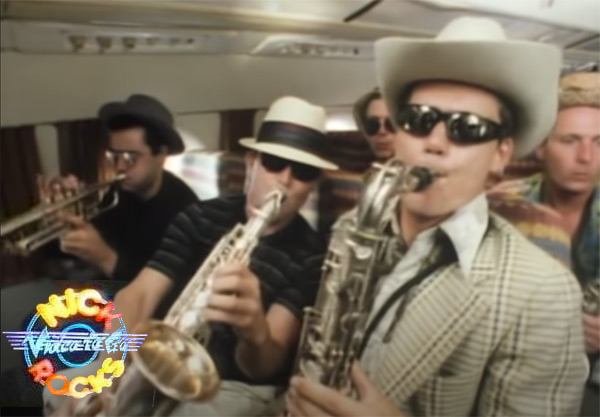
I finally got to hear “Wings of a Dove,” which had been intriguingly mentioned as their new UK single in a Trouser Press article. Madness plus steel drums plus hallelujah gospel choir? Totally loved it. The music video for that track became a lot more widely played in the U.S. than “The Sun and the Rain,” finding heavy rotation on Nickelodeon’s Nick Rocks video program. I remember their credits subtitled the song as “Wings of a Dove (A Celebrity Song)” instead of Celebratory. I think the gimmick with the van parachuting out of the plane helped to sustain the faint impression of Madness in the American consciousness, at least among teens and tweens.
Funny thing about “Victoria Gardens” – listening to it, I thought the chorus sounded kinda like The English Beat, whose What Is Beat? greatest hits I had recently got. The liner notes cryptically credited “General Public: Back Vox,” which I thought literally meant they had recorded strangers off the street. It was a few months later that a catchy single called “Tenderness” hit the airwaves, I learned the name of Dave Wakeling and Ranking Roger’s new band, and the penny dropped.
Keep Moving has always been my Madness album for Sundays. Maybe in part since I actually got it on a Sunday, but mainly because it has that relaxed, easygoing lazy Sunday afternoon mood. Certainly compared to the caffeinated jump of most of their other records, Keep Moving is the one to chill out to. The album also has a pleasantly old-timey sound that’s hard to put in words. It reminds me of idyllic 19th century paintings of gents in barbershop quartet outfits on pennyfarthing bicycles and ladies with parasols strolling through the park, especially “Brand New Beat,” “March of the Gherkins” and “Prospects.” These are not typical pop songs of the ’80s. They are from another time. I remember many times mowing the yard with Keep Moving on my Walkman, and laughing to myself, “Man, no other kid in North Carolina is playing this kind of music.” I was proud to be weird, and still am.
Years later, when compact discs came along, I was in for a long-overdue discovery. Getting a batch of Madness import CDs through mail order, I found to my dismay that the songs on Keep Moving were totally screwed up. And the two biggest songs, the ones with the great music videos, weren’t even on there at all! What the hell? What kind of lousy botched job had I got cheated on? Ridiculous!
And that’s when I figured it out. The original official Keep Moving had a totally different running order than the one I knew and loved. Most significantly, “The Sun and the Rain” and “Wings of a Dove,” which had been released as UK singles in 1983, were not included on the album. This was the dreadful truth. The real “two bonus songs” included on my Geffen cassette weren’t “Time for Tea” and “Waltz into Mischief” at all. AAAarrrghghhh! NOOOOOOO!
Well, damn. All I can say is that whoever the Geffen executive or producer was who assembled and packaged their release of the album, they were a total genius. They didn’t just arbitrarily scramble the running order, they clearly put constructive strategy behind it. Because like I said, the North American edition of Keep Moving album is infinitely superior to the original British release in every possible way. Just take a look.
🇬🇧 1. Keep Moving
🇺🇸 1. Keep Moving
🇬🇧 2. Michael Caine
🇺🇸 2. Wings of a Dove (A Celebratory Song)
🇬🇧 3. Turning Blue
🇺🇸 3. The Sun and the Rain
🇬🇧 4. One Better Day
🇺🇸 4. Brand New Beat
🇬🇧 5. March of the Gherkins
🇺🇸 5. March of the Gherkins
🇬🇧 6. Waltz into Mischief
🇺🇸 6. Michael Caine
🇬🇧 7. Brand New Beat
🇺🇸 7. Time for Tea*
🇬🇧 8. Victoria Gardens
🇺🇸 8. Prospects
🇬🇧 9. Samantha
🇺🇸 9. Victoria Gardens
🇬🇧 10. Time for Tea
🇺🇸 10. Samantha
🇬🇧 11. Prospects
🇺🇸 11. One Better Day
🇬🇧 12. Give Me a Reason
🇺🇸 12. Give Me a Reason
🇺🇸 13. Turning Blue
🇺🇸 14. Waltz into Mischief* * U.S. cassette only
“Keep Moving,” “Wings of a Dove,” “The Sun and the Rain.” Boom, that’s an epic trilogy of an album opener. I’ve heard UK fans remark that the two singles clash with the tone of the album and don’t belong. Nonsense. I think they mesh splendidly with the band’s refined new sound.
The last fading notes of “Brand New Beat” ring in “March of the Gherkins” without a pause, like “Heartbreaker” segues into “Living Loving Maid,” or “Sgt. Pepper’s Lonely Hearts Club Band” into “With a Little Help from My Friends.” Separating them is sheer folly.
“Michael Caine” gets a comfortable buildup before its cinematic atmosphere unfolds. It’s a good song, but I don’t think shoulders the weight of the album’s #2 position. Sharing a sense of spy novel intrigue, “Time for Tea” feels right as an off-kilter epilogue.
“Prospects” is a quintessential Side 2 starter, resetting the table for the album’s next movement. The song’s languid outro nicely tees up Dave and Roger’s merry bounce into “Victoria Gardens.”
The brooding “Samantha” turns the corner into the dark heart of Keep Moving, leading off a suite of four minor-key-type tunes that mean serious business. The emotional catharsis of “One Better Day,” the suspense-thriller soundtrack climax of “Give Me a Reason,” the urgent denouement of “Turning Blue.”
“Waltz into Mischief” supplies the much-needed cooldown and signoff, as a raucous pint-raising singalong chorus gives way to chuffed strings and brass winding down to a stop.
I just can’t listen to the UK Keep Moving. It doesn’t make sense to me, and the beautiful flow is not there. It’s amazing how much difference the sequencing of songs can make. When I gained the technology to burn my own CDs, the first thing I did was create a disc of the American Keep Moving. Geffen eventually issued it on CD in the U.S., thank goodness, almost matching the old cassette but with “Time for Tea” inserted as track 13 instead of track 6. Not perfect, but close enough to be serviceable.
All that being said, and as much as I relish chanting “USA! USA!” in this specific context, I freely admit that it’s all subjective. When a creative work comes in multiple variants, in films or books or music, you’ll always prefer the version that you fell in love with, whether it was the original or altered or what. I’ve actually had the exact same experience with another landmark British pop album from 1984: I’m biased toward the Style Council’s American My Ever Changing Moods album, even though Paul Weller fans almost unanimously revere the original Café Bleu. Fair play to all the other Madness fans who likewise feel their treasured edition of Keep Moving is flawless and unbeatable.
To borrow a phrase from the pen of Lee Thompson: Star-shaped badges that shine around, called “Wings of a Dove” and “The Sun and the Rain,” come free in your U.S. Keep Moving bumper pack. But if a different tracklist is left around too long, it’ll burn right through to your heart and your soul.
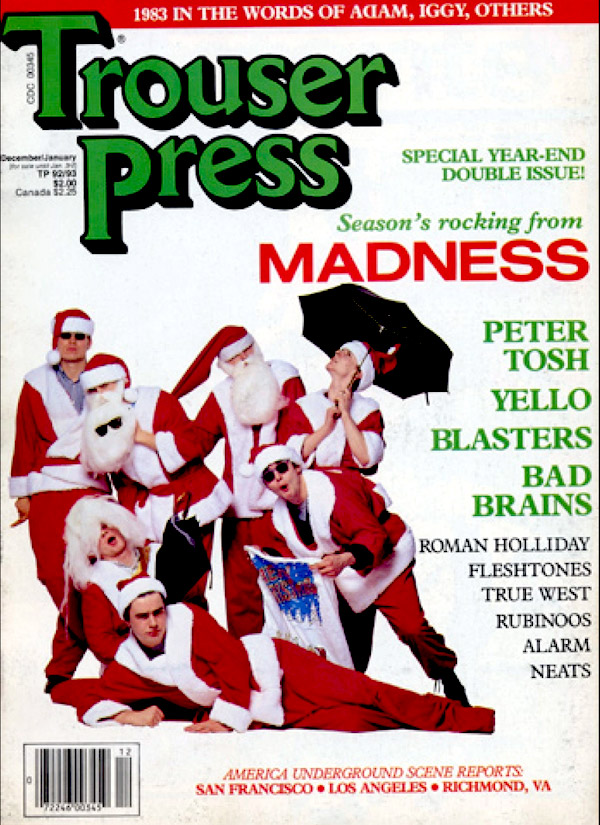
Trouser Press was a legendary U.S. alternative rock magazine published from 1974 to 1984, perhaps best known for its comprehensive Trouser Press Record Guide books. The following is a fantastic article by Jim Green that ran as the cover feature in the magazine’s penultimate issue dated December 1983/January 1984.
This was the single most memorable and important piece of journalism I read on Madness in my first year as a fan. It taught me a lot of the fundamentals of the Madness backstory (how they got their name, the 2 Tone connection, Carl’s evolving role) and gave a peek into how the sausage of the Geffen U.S. album was made (how traumatizing for Suggs to spit “I don’t like it”!). This was the first time I ever heard of their “current British single, ‘Wings of a Dove,’” many long months before I would actually hear the song. And in retrospect, how amusing indeed to see young Suggs decry the horrific notion of a Madness concept album with 14-minute songs. So please enjoy this fine Trouser Press profile, in its transience and in its permanence…
The transatlantic telephone line is dominated by the muffled distortion and hiss common to calls made across a thousand leagues of water; the voice at the other end also cuts off intermittently for split-second intervals. At one point, though, the speaker obviously pauses, as if to gather his thoughts on a subject he rarely discusses, at least not with the press.
‘‘The image of the band is itself almost as strong as the music, if not more memorable, to the average person,” says Graham McPherson. He is referring to Madness, the group in which he is lead vocalist (and, true to form, in which role he is far better known as “Suggs”).
“I don’t know if it’s right or not,” he continues hesitantly, “but musically we’ve been looked on as something instant, not really worthy of analysis.”
Nobody would argue that, least of all McPherson’s bandmates – until the release of the septet’s fourth British album, The Rise and Fall. Madness has moved into new musical and lyrical ground, with the fullest realization of their capabilities to date. Yet the record incurred critical brickbats from the British music press, which characterized it as depressing, and – unkindest cut of all? – “said you couldn’t put most of the songs from it on the jukebox.”
What a switch from the days when Madness was branded too frivolous and lacking in the “socially relevant” virtues of the other outfits with which it was lumped: Selecter, the Beat and the Specials. (The last were the so-called vanguard of neo-ska and proprietors of the 2 Tone label on which the others got their starts.) But Madness has rarely received comment from the Britpress, positive or negative, that hasn’t been based on one prejudgment or another.
That the group suddenly matured isn’t, in the members’ own eyes, deserving of celebration by the press. Nor do they seek the critical scrutiny and interpretation inflicted on artists like Elvis Costello or even the Jam. They just want a fair shake.
If McPherson, bassist Mark Bedford and guitarist Chris Foreman (the latter two available to chat during this summer’s US tour) are representative of their bandmates, one of Madness’s most salient characteristics is a distinct lack of self-consciousness. Madness most likely would have entered the 2 Tone graveyard long ago if they’d been more calculating than what they’ve always been: a bunch of friends who like making music together.
Mark Bedford: “If anything, we’re more influenced by outside sources now than when we started. Back then” – when they were mostly in their late teens – “we, like most kids, thought we knew it all; no-one could tell us anything.”
When Madness started, as the North London Invaders in 1978, there was no “movement” or trend. The band did what they enjoyed, even if few pubs encouraged them.
Another band called the Invaders (from West Yorkshire) staked a claim on the name, necessitating a switch. No one was satisfied with Morris & the Minors (a pun on a British automobile). Then Foreman suggested rechristening the group after one of their songs. As a jokey example he mentioned “Madness”; Prince Buster’s ’60s ska hit was a keynote of their set.
To Foreman’s dismay, the others leapt on it at once. “I didn’t like it,” he says. “I thought it was the kind of thing for an Alice Cooper-type band. But it stuck.”
McPherson now is bemused by the group’s youthfully naive élan in those days. “Like anybody, you don’t really imagine or realize that you’ll be a great success. We always knew, when we were young, that anything we did would be brilliant. Every time we played we expected everyone to go mad, but it didn’t go beyond an immediate enthusiasm for impressing people, as opposed to becoming nationally successful.”
In early 1979 the Specials created 2 Tone and garnered lots of attention. When word got out that they were looking for other groups to put on their label, Madness jumped at the chance. “We sent them a cassette – a rehearsal tape, really,” Foreman says, grimacing.
“Jerry Dammers [the head Special] still has it!” Bedford laughs. “He told me he still listens to it once in a while and has a laugh.”
Still, Dammers and company heard something of merit in it. By September, Madness was enjoying its first bit with its tribute to Buster, “The Prince.”
“We weren’t mugs,” Foreman asserts. “We wanted to get an album out right away.”
“We wanted to do it with 2 Tone,” Bedford adds, “but [the Specials] only had money enough to do their own album.”
Label shopping resulted in their signing to Stiff. An LP, One Step Beyond, was quickly recorded and followed its namesake single into the UK Top 10; the album went platinum during its 64-week chart residency.
Other bit singles followed. Madness’s albums sold even better than most of their 45s, but English pundits jeered the group for being a “singles band” – as if that somehow cheapened the success. Image problems persisted. Madness suffered in the aforementioned comparisons with their former 2 Tone mates (or, for that matter, whichever “serious” new world-beaters were current press favorites).
“We never said, ‘We’re a ska band,’” Foreman claims. “We never put those limits on what we were doing.”
“That’s musical suicide, sooner or later,” Bedford says.
“Other people lumped us into that but we didn’t mind; we knew what we could do,” Foreman adds. “Calling our music the ‘Nutty Sound’ was a way to avoid categorizing ourselves. ‘Nutty’ was just a word Lee [saxman Thompson] used a lot, and someone picked up on it.”
The “Nutty Boys” might have smacked all too much of bubblegum-style merchandising, but even skeptics found it hard not to be taken in by Madness’s wacky antics in front of movie or video cameras. The group released a semi-autobiographical feature film, Take It or Leave It, in October, 1981, and then Complete Madness, a compendium of videos with added linkage and a pair of their Japanese TV commercials thrown in for good measure. And they remained overwhelmingly popular in the UK.
What could be wrong? Gradually, band members got married – notably McPherson to songstress Bette Bright, and drummer Dan “Woody” Woodgate to ex-Mo-dettes bassist Jane Crockford – and started families. But something was brewing.
Bedford admits the marriages have crimped Madness’s former camaraderie. And he and Foreman are both less than pleased with the band’s third album, Seven (despite its spawning “House of Fun,” Madness’s first Number One single).
McPherson remembers the situation more clearly: “I was satisfied with Seven, but the others weren’t. We didn’t have the best feeling when we recorded it, in Nassau in the Bahamas; I think we were pressin’ down there, which was very strange.
“It started feeling very professional. That side of things was becoming more prevalent than with the previous two albums, where it was pure luck we were there at all.
“Clive [Langer] and Alan [Winstanley], our producers all along, became scapegoats since they were in control of the proceedings.
“After we got back to London we were thinking of trying other producers. We met Trevor Horn, whom no one got along with. It made us realize how good Clive and Alan are as communicators, apart from everything else. It brought us closer together again.”
Madness then created their best album by far. What made the difference?Just a better atmosphere while it was being recorded?
Bedford and Foreman mention that the band’s working up different arrangements of the same number had a key effect. McPherson puts that new (for Madness) technique into a larger context.
“I think we realized that maybe we had been restricting ourselves, just like any bunch of kids will do. It’s like we weren’t ‘allowed’ to do certain things; none of us would have grown a beard, for instance, and musically it was probably the same. Certain things were ‘uncool,’ like to do introspective stuff. The Rise and Fall was generally more thought out. It’s the first album we’ve made that’s an album, not a collection of songs.”
Indeed. Would you believe a Madness concept album?
“It was gonna be about the rise and fall of a normal person in a particular area that was falling into bad times. ‘Rise and Fall,’ ‘Primrose Hill,’ ‘Sunday Morning’ and ‘Blue Skinned Beast’ were all linked together. But as other songs started to be written, it kind of lost its way. We realized you had to write songs to fill in bits of the story, to keep it moving, but that they might not be very good or able to stand on their own.” McPherson sighs at the thought of “14-minute songs” and such – heaven forfend!
The way the album jelled reveals the vital interaction of Madness’s members. Foreman and keyboardist Mike Barson have long been the songwriting mainstays as well as musical arrangers; Bedford, who’s now writing less, is getting into technical aspects.
“I saw him reading a technical book on engineering,” McPherson says, “and he’s produced singles by two bands, Bonsai Forest and Strawberry Switchblade. Now at least one of us understands what’s going on at that end of things.”
“Woody docs the sleeping for the band,” Bedford jokes, while pointing out that Woodgate did write “Sunday Morning.” McPherson mentions that everyone has taken a more active interest in writing – collaborating more than ever – and arranging.
“That’s part of the reason we’ve stayed together,” he explains. “There’s no pressure on any one person to think of a concept or do all the songs.”
The piece of the Madness puzzle that’s fallen into place is vocalist and trumpet player Carl Smyth – best remembered by early American fans of the group as the zany seventh member, “Chas Smash.”
Smyth got involved with Madness as a friend whose dance antics and vocal hijinks (he’s the voice on “One Step Beyond”) were worked into the group. But he seemed something of a fifth (or in this case seventh) wheel; he doesn’t appear on the cover of the first album.
“There was a funny period just after One Step Beyond that Carl didn’t have much to do with,” McPherson says. “He was a member of the band, but he wasn’t really involved with anybody else – particularly me, because we’re both singers. We talked about it between ourselves, and it must have been strange for him; I think he felt he was sort of outside us, yet felt changing that would be pushing me out. He didn’t push his position ’cause he didn’t know what it was. But we decided that whoever had the right thing, be it words or music or singing, we’d do whatever seemed right.”
Smyth’s enthusiasm is evidently catching. “He’ll have a million ideas when we start talking about videos,” McPherson says, “another million when we’re getting things together for it, and when we’re actually doing it he’ll have a million more. It’s like he had something bottled up in him and suddenly the cork sprang out. He’s brilliant. We probably wouldn’t be here if he wasn’t like he was, because out of every million ideas come 10 really good ones.
“And he’s always thinking of dance routines we can do, or whatever. If things start flagging a bit, he’ll pick us up.”
Now known within the group as “Mr. Bosh,” Smyth reverted to his given name for songwriting credits. Since co-writing “Cardiac Arrest,” a hit single on Seven, Smyth has made several important contributions – notably co-writing “Our House” (“Carl lives in one very much like that,” Foreman says), “Tomorrow’s Just Another Day” and the current British single, “Wings of a Dove.”
Madness fans got a bonus with the British single version of “Tomorrow’s Just Another Day”: a guest lead vocal by Elvis Costello.
“I’d heard an old rockabilly song,” McPherson says, “which started out with a bluesy version, then faded out and back in to a rocked-up arrangement. I thought it’d be great to have something like that on ‘Tomorrow’s Just Another Day’ – an arrangement that sounded old and bluesy, just 20 seconds at the beginning of the song, and then cross-fading into the newer version, which we’d already done.
“The backing track was cut, slowed down a bit and quite good. But I couldn’t come to grips with real singing. So Carl had a go; he did a good version, jazzed up a bit in the phrasing, but it still didn’t sound quite right.
“By that time we’d finished the album and still had this backing track. Clive was soon going to be producing the new Elvis Costello album, and I think Chris suggested he ask Elvis to try it. He was really good; came in, did it and left. If he hadn’t, we’d still have that backing track sitting around! I think it was one of the best vocals he’s ever done.” Perhaps in deference to Madness, Costello sang with a British accent, which he also tried out on Punch the Clock.
In the US, Sire Records had released One Step Beyond and its follow-up, Absolutely; both albums promptly died the death. Sire didn’t bother with Seven, but Madness, hugely successful everywhere else, wasn’t too concerned. “We didn’t tum our back on America, really,” Foreman says. “We just kind of forgot about it.”
According to Geffen Records A&R man Danny Heaps, however, US labels didn’t forget about Madness – especially as the group racked up hit after hit in England and Europe. In early 1983, Heaps says, Madness approached Geffen – a hot new company that had just started the last time the band had an American release.
“They were a logical signing. Remember, at that time Dexy’s was number one here. And you know, that stuff about Madness being ‘too English’ for the US is nonsense.”
“We picked Geffen for the same reasons we signed with Stiff,” Bedford says, “because of the people we talked to. They accepted us for what we are – not saying, ‘You’re great but you’ll have to do this and you ought to do that.”‘
Geffen released Madness, a compilation drawn mostly from The Rise and Fall but digging as far back as the first album.
“I don’t like it,” McPherson states. “It’s a scrapbook, not an album.”
Foreman is more philosophic. “Programming the album that way is, well, the way things are done for the US. I didn’t used to feel this way about it, but now I realize it has to be.”
Heaps argues that Geffen’s track selection, “instead of putting out all of The Rise and Fall, was purely commercial logic. The stuff from Seven, which includes singles, has never been out here – and ‘Night Boat to Cairo’ [from One Step Beyond] is just a track someone in the company really wanted on there. We wanted to put on ‘Madness’ or ‘The Prince,’ but the group would allow only so much of our delving into the past.”
The “commercial logic” paid off. Madness has sold over 200,000 copies, and spun off two hit singles: the Top 10 “Our House” and a version of Labi Siffre’s “It Must Be Love.”
Future plans? Typically, McPherson chuckles and quips that he’s anxious to “have some of the stew that my beautiful wife’s knockin’ up on the cooker.” More seriously, he’s looking ahead to the next Madness album. Recording began last spring, before an American tour, and resumed this autumn.
“Before we recorded The Rise and Fall,’’ Bedford says, “the mood of the country was pretty grey.” He mentions Britain’s economy and the Falklands war, referred to in “Blue Skinned Beast” – dead soldiers were put into blue body bags. In contrast, Madness’s spring studio session were much more uptempo.
“We’re looking out for our more introspective tendencies,’’ McPherson says, “even though we’re not sure we’ve been going into them that heavily, so we can balance that with our more flamboyant side.”
Madness getting self-conscious? Losing artistic innocence? Maybe… and maybe not. McPherson still believes in group dynamics.
“The Rise and Fall succeeded because there was so much collaboration. Everyone had to stay interested, or we wouldn’t know what was going on the record! People change and grow together when they get so intensely involved. I think we were all in the same groove, the same vein, when we made that record.”
That’s what he thinks makes Madness yield up its best work: democratic anarchy.
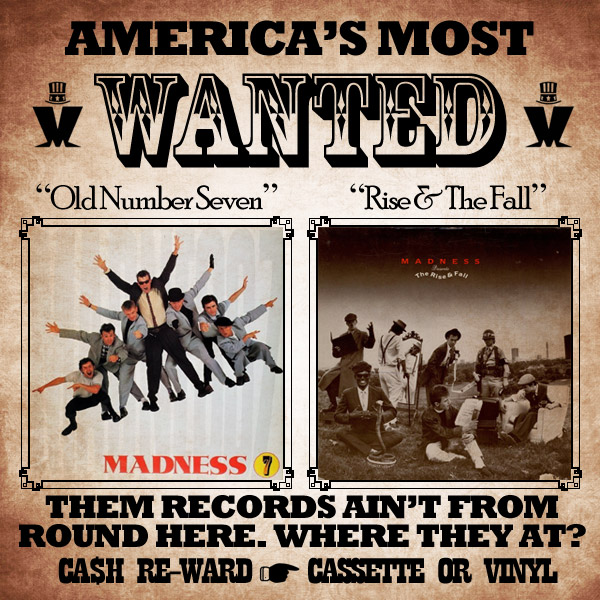
Back when I was a newly minted Madness fan, after “Our House,” One Step Beyond and Absolutely had won me over, I found myself on the horns of an international crisis. Pop journalism informed me that the band had another two full albums to its credit: 7 from 1981, and The Rise and Fall from 1982. But since Sire Records had dropped Madness before their big 1983 hit, those two most recent records remained the stuff of legend in the United States. That didn’t stop me from checking the “M” section at every record store in obsessive-compulsive vain, though I knew the search was going to require purveyors of exotic imported goods. And I would have to deal not only in foreign commodities, but also with a foreign format: the vinyl LP.
In all my music-loving life, I have never been a vinyl person. I did grow up in a home with a turntable, and my parents had a decent stack of country music LPs stashed in the closet by the likes of Conway Twitty, Hank Snow and Dolly Parton. But I never remember Mom and Dad playing records. They always just listened to the radio. My older sister had her vinyl collection with The Carpenters, Neil Sedaka and Frampton Comes Alive!, which of course she never wanted me messing with. I was raised on 8-track tapes and later cassettes. Only rarely did I ever own anything on vinyl beyond kiddie records. I demanded for my folks to get me the Kiss Alive II double LP, only because someone brought a copy to school and showed off all the cool scratch-off tattoos and goodies that didn’t come with the cassette. And I had a few odd 45 rpm singles like “Our Lips Are Sealed” by the Go-Go’s (major crush on Belinda Carlisle) and “Rapture” by Blondie (which I got by mailing in Pop-Tarts box tops).
Frankly, I just never liked vinyl. The sound was all crackly and prone to skipping. It was a pain to flip the record over. They were so fragile and easy to wreck with a single scratch or stray wisps of dust. Vinyl lovers extoll the “warmth and richness” of the “superior dynamic analog” whatever, and more power to ’em. They can take those old records off the shelf and sit and listen to ’em by themselves. In my book, tapes sounded way better than phonograph platters then, and well-mastered compact discs sound way better now. Yep, I think vinyl sucks.
But if I ever wanted to obtain the elusive 7 and The Rise and Fall as a teenager, I was going to have to settle for the import LPs. With a bit of work, I ended up scoring them both. Looking back now, I see evidence that Stiff Records did in fact release them on cassette, which would have been a blessing beyond imagination to my younger self. I gather that the market share for cassettes was quite smaller in the UK than in America, and in my music collecting experience I can’t recall ever seeing, in person, import cassettes by artists I like. You’d have to turn to our friends at Retro Madness to procure such rare museum-class artifacts.
I actually found The Rise and Fall first, to make my reversed timeline of Madness catalogue discovery all the more knotty. The band’s fourth album turned up at an eclectic record shop in Asheville, North Carolina. It may have been a used copy, but if so it was in nice condition. Of course I was amazed to lay my lucky hands on it, but not unreservedly thrilled. For one thing, by that point we no longer had a record player in my house. Either we’d gotten rid of the old turntable for some reason, or my sister had taken it when she’d moved out. On top of that, I thought the price on the LP was outrageous. I don’t recall how much exactly, but it was probably around $15 – exorbitant by my financial standards at the time. The very idea of shelling out twice the cost of an average cassette tape, for a record I couldn’t even play at home, and half of whose songs I already had on the Geffen compilation? Sworn to Madness allegiance though I was, it was still a bitter pill to gulp down.
Stirring further consternation was a little grocery-store-style sticker on the back of the LP sleeve: “MADE IN SPAIN.” Whoa! An import not from England’s mountains green, but shipped all the way from the land of tapas and toreros! It bore the Stiff Records label, though the fine print specified “Editado por Discos Victoria, S.A,, distribuido por Edigsa.” With grave concern I went to ask the shop clerk: “If this record’s made in Spain, will the singing still be in English?” He assured me with amusement it would be. It’s a good thing I was unaware of “Un Paso Adelante” at that point. ¡Ay, caramba!
So I purchased my Spanish-but-not-Español Madness record and took it to my aunt’s house to give it a first listen, before getting a friend to make a good cassette recording on his stereo system. I recall my first impression was… underwhelmed. I could see why Geffen had fashioned a compilation for U.S. listeners instead of issuing The Rise and Fall. Tracks like “Mr Speaker (Gets the Word)” and “New Delhi” just aren’t very strong. “Sunday Morning” is charming enough, but it comes across as a less successful variation on the same themes as “Our House.” (Probably as evidence that only Chas and Woody contributed songs about their upbringings, per the album’s original concept.)
I was more impressed with the clever verbosity of “Tiptoes” (rhyming “the door’s already shutting” with “to reach the 19th button”!) and the unusual musical structure of “That Face.” To me, Mike Barson’s piano and Mark Bedford’s bass are the quintessential elements of the Madness sound, and it’s remarkable how “That Face” arranges their parts in minimalistic bursts that create both tension and airiness in the gaps between. It’s a mature new style that points toward the direction of Keep Moving.
In my 11th grade English class, we had an assignment to present a song of our choice to the class and analyze its lyrics like poetry. Mrs. Caldwell told us to find songs with more artistic or social relevance than “baby baby let’s party” or whatever. I chose to discuss “Are You Coming (With Me)” and dissect its bleak message of trying to reach a self-destructive friend in the throes of drug addiction. Looking back, I wonder why I didn’t pick some other Madness tune like “Embarrassment” – another Lee Thompson composition with a meaningful story behind it, and a catchier melody. I believe in part I liked the idea of playing this tape recorded from a super obscure record that none of my captive audience would ever hear otherwise. And it was an opportunity to show that my favorite band could do something more serious and soulful than that “house in the middle of the street” ditty.
Not long after I got The Rise and Fall, I acquired the 7 album through mail order. My friends and I had discovered a company called Burning Airlines (still in business since 1978!) that sold music T-shirts and merch. We had sent away for their full catalog, and among the typewriter-keyed listings of import LPs I spotted “Madness 7.” I’m sure it must have cost even more than what I’d shelled out for The Rise and Fall, but price could no longer deter me. I had to gain the one remaining “lost” Madness album by any means necessary. I know one motivating factor was my OCD need for something to put on the blank side of my Rise and Fall tape. Less rewinding!
Once I finally got it transferred to the B-side of that cassette, I was generally more pleased with 7 at first blush than I’d been with The Rise and Fall – not least because it had a greater number of new-to-me tracks, a total of ten. And of the familiar ones, two were different mixes. Compared to the Geffen Madness album, “Cardiac Arrest” was shorter and “Shut Up” was longer. In both cases I prefer the extended outro versions. I became an instant fan of “Tomorrow’s Dream” (nothing at all like the Black Sabbath song), “Benny Bullfrog” (favored among my friends that I tried to convert to Madness), and “The Opium Eaters” (proof that the band could really do a brilliant film soundtrack). I’ve always thought “Day on the Town” is underrated and deceptively chilling, a dub-tinged spiritual cousin to The Specials’ “Ghost Town.”
One particular track holds dark personal memories for me. When was in my first fender-bender as a newly licensed young driver, 7 was playing in my Oldsmobile Cutlass tape deck. I got rear-ended on the highway, and just as I braked to a screeching halt, the opening bars of “Sign of the Times” chimed out, Barson’s plonked keys taunting “ding-ding-ding, ding-ding-da-ding!” at me like a game-show loser alarm. I couldn’t bear to listen to 7 for months from the PTSD flashbacks.
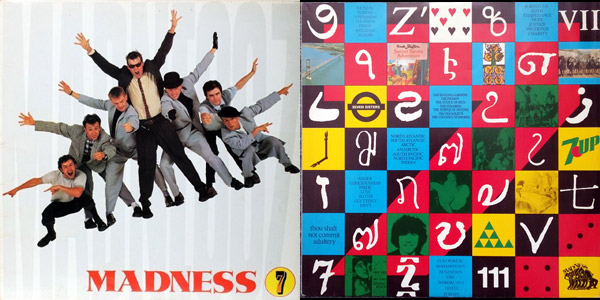
Another thing I have to mention about 7 is the album cover. I still think it’s the best artwork on any Madness album ever, even better than the iconic nutty train. On the Divine Madness DVD commentary track, Chas and Mike argue about which one of them choreographed the 7 pose, which reminds me of a superhero team splash page. In fact, I had a poster of it on my bedroom wall since I first became a Madness fan, which surely predisposed me to like the album once I finally got it. And I love the inner sleeve with the 7×7 checkerboard grid of famous sevens, septets and sevenths: the 7 deadly sins, the 7 wonders of the world, the 7 seas, Seven Samurai, 7Up… so awesome! As I had done with The Rise and Fall, I finagled this album into another school assignment by drawing a detailed pencil study of that epic 7 cover. Poor Mrs. Williams also had to grade me on a rendering of Big Country’s Stuart Adamson in pastels, and a giant mural painting of Beta Ray Bill from The Mighty Thor.
Once I got my first CD player in 1987 as a college freshman, I was able to track down all the Madness albums on import CDs within a couple of years. And boy, did 7 and The Rise and Fall benefit from crystal clarity in place of the snap, crackle, pop of my LP recordings. Vinyl, I still hate your guts. But I thank you for making some important introductions and lasting connections in my life. To paraphrase that song that heckled me at the terrifying instant of my first car wreck:
This is disposable, throw it away This is on vinyl, don’t let it play That was the past, so leave it behind I found the music, it’s all in my mind
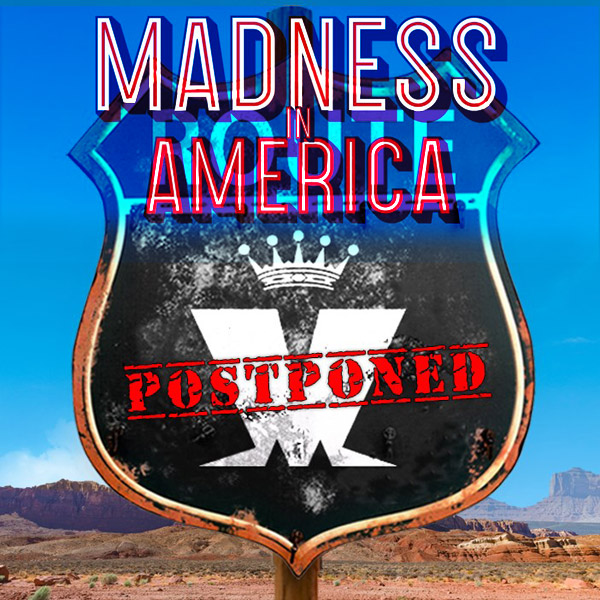
To no surprise, the Madness U.S. tour dates scheduled for May 2020 have been pushed to next year. The newly announced 2021 dates are as follows:
5/26/2021
Hammerstein Ballroom, New York, NY
5/28/2021
House of Blues, Boston, MA
5/30/2021
The Greek Theatre, Los Angeles, CA
5/31/2021
Punk Rock Bowling & Music Festival, Las Vegas, NV
6/2/2021 6/3/2021
The Fox Theater, Oakland, CA
Tickets booked for the 2020 dates will be honored at the rescheduled shows. The Madness Facebook page advises contacting your point of purchase if you will be unable to attend.
Everyone stay safe and stay tuned to Stateside Madness for any further updates as they become available!
UPDATE: On April 13, Madness was confirmed for the Las Vegas festival date added above.





 Stateside Madness