
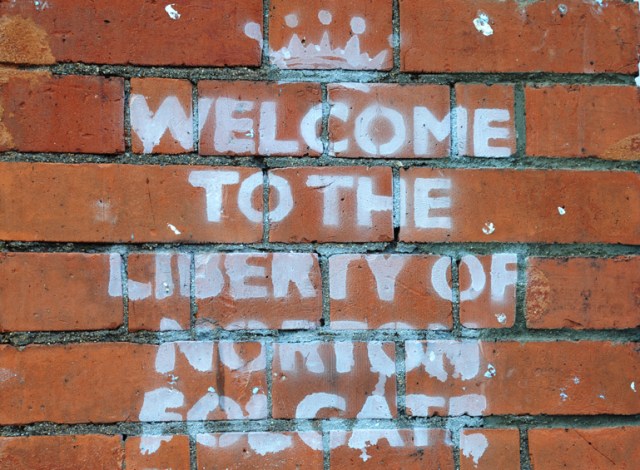
Editor’s Note: Welcome aboard our first guest blogger: Laurie Alfaro, Stateside Madness Social Media Director and Podcast Producer. Laurie has contributed this glossary in conjunction with her deep-dive podcast on The Liberty of Norton Folgate. Sit back, relax, and we’ll travel many a long dim silent street… together! – D. Trull
In 2009, Madness released their magnum opus The Liberty of Norton Folgate, a concept album referring to a small area in east London named after Norton Folgate Street. Historically, this area was known for its colorful immigrant population, especially in Victorian times. Rightly or wrongly, the Liberty of Norton Folgate had a reputation for lawlessness, crime, and prostitution.
The album concludes with the ten-minute, ten-second epic title track, “The Liberty of Norton Folgate.” The song references many people and places in Victorian England that may not be known to American audiences. In this article, I will outline the people and places mentioned in the song to give listeners some context so that they can truly appreciate this masterpiece.
“This is the story of the Liberty of Norton Folgate” (0:10)
As we learned in Episode #23 of the Stateside Madness Podcast, Norton Folgate was a liberty in Middlesex, England, adjacent to the City of London in what would eventually become the East End of London. A “liberty” is an area in which rights reserved to the king had been devolved into private hands; in other words, it was self-governed, ruled by a court of ten elected officers who derived their authority from the people. Notable for the time, the elected officers included women. It was an 8.7-acre site originally occupied by the Priory and Hospital of St. Mary Spital. Playwright Christopher Marlowe was a resident of Norton Folgate, and the first-ever staging of a Charles Dickens play was held at the City of London Theatre in Norton Folgate (titled The Pickwick Club or The Age We Live In). William Shakespeare himself reportedly lived and worked in the neighborhood as well.
For some great info about the Liberty of Norton Folgate, see the brochure Save Norton Folgate.
Old Jack Norris, the “Musical Shrimp” (0:22)
Taken from the 1824 book, The Cabinet of Curiosities; Or, Wonders of the World Displayed:
A short time ago Old Jack Norris died suddenly and an inquest was held on the body, before Mr. Stirling, Coroner, at the Black Horse, George-street, St. Giles’s. It was reported the deceased had starved to death. The evidence proved, that latterly the deceased, who was nearly seventy years of age, was unable to pursue his occupation of a dealer in shrimps, which, from his peculiar cry, gained him the appellation of the “Musical Shrimp Man”….
Battling Levinsky versus Jackie Berg (0:42)

Battling Levinsky was the world light heavyweight champion from 1916 to 1920. Jack Kid Berg, or Jackie Kid Berg, was an English boxer born in the East End of London who became the World Light Welterweight Champion in 1930. Both were inducted into the International Jewish Sports Hall of Fame. Since their boxing careers took place much later than Victorian times, their inclusion may seem like an anachronism; but after all, Suggs is taking a broad survey of Norton Folgate’s history that extends to street hucksters flogging bootleg DVDs.
Arnold Circus (2:00)
This area had once been one of the worst slums in London. In 1890, the entire area was razed, and a new housing development was built in its place. According to Atlas Obscura:
Rather than lifting London’s poorest from squalor, the Boundary Estate forced them into neighboring slums. The construction of the estate did, however, succeed in revitalizing the immediate neighborhood. Crime and violence in the area decreased substantially and Arnold Circus was viewed as a haven by London’s Jewish immigrant community.
Petticoat Lane (2:03)
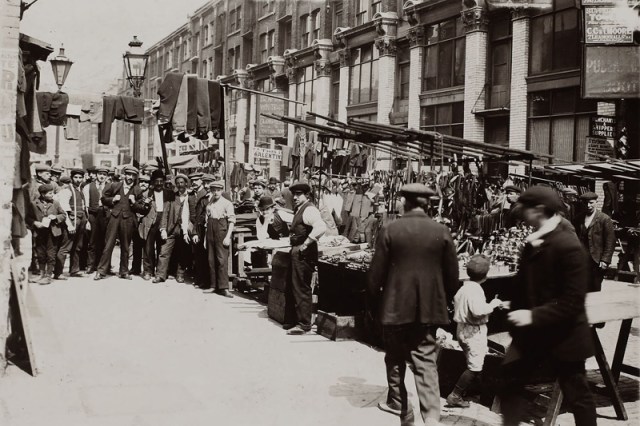
A clothing market in Spitalfields. In the late 1800s, the area experienced a wave of Jewish immigrants fleeing persecution. Many of these immigrants went into the garment industry and set up stalls in the clothing market.
The Well of Shadows (2:04)
According to author Ed O’Regan, the Well of Shadows is a play on words referring to Shadwell in London’s East End. (Shadwell = Shad Well, Well of Shadows.) In his book Well of Shadows, Underground London (AS Publishing, 2013), he writes:
The social history of London’s East End is that wave upon wave of poor and/or dispossessed immigrants: Hugenots [sic], Irish, Jews and, more recently, Bangladeshis.
The local gang of Bangladeshi youths called itself ‘The Shadwell Massive’.
In Victorian times, the Shadwell area was a slum where opium dens and prostitution were rampant.
Archipelago of Malay (2:33)
This refers to the island chain between Australia and mainland Indochina. The Malay Archipelago consists of 25,000 islands and islets, including East Malaysia, Indonesia, Papua New Guinea, and the Philippines. Portions of the archipelago were ceded to the British Empire under the Anglo-Dutch Treaty of 1824.
Shadwell’s Tiger Bay (2:39)
Shadwell, mentioned earlier in the song, was a popular docking location for ships traveling up the River Thames. The rough-and-tumble nature of the area surrounding the docks earned it the nickname “Tiger Bay.” According to Ed Fisher in The Dictionary of Victorian London:
During the Victorian times, “Tiger Bay” was used (mostly by sailors but by others as well) to refer to various of the worst slum areas or districts as well as a few actual streets near the east-end London docks. Allegedly, the nickname was inspired by the awful nature of the brothels (and their operators) in the worst areas where many of the sailors were so badly treated.
“The Welsh and Irish wagtails” (2:45)
A wagtail is a songbird. Here, the wagtail is a metaphor for the people from Wales and Ireland and their native music. This thought continues in the next line, as “The music hall carousal is spilling out into bonfire light.”
Mr. Truman’s beer factory (3:06)
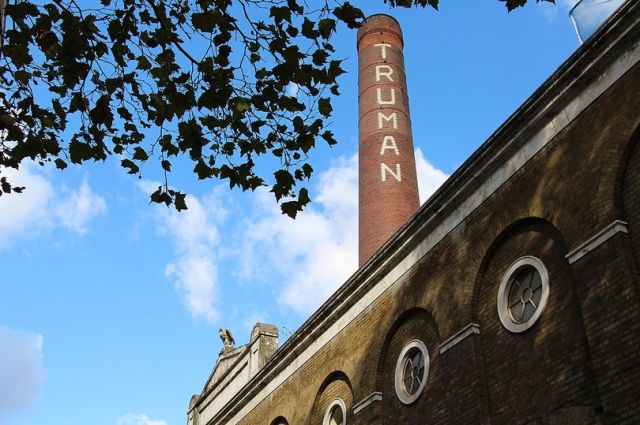
Located on Brick Lane in Tower Hamlets, Truman’s Brewery was once the largest brewery in the world. “Giants dancing up the brick wall” refers to the shadows of drunken revelers cast across the building’s iconic brick exterior. Joseph Truman became owner of the facility in 1683 or thereabouts. (Records from this time are a bit sketchy.) The brewery was passed down over many generations in the Truman family. Its famous 160-foot chimney is now a historical landmark. Today, The Old Truman Brewery is an events space and cultural center.
Spitalfields, Whitechapel, Tower Hamlets (3:14)
Spitalfields and Whitechapel are districts in the East End of London within the London borough of Tower Hamlets. Known for its dense immigrant population, in Victorian times this area was most famous as the hunting grounds of Jack the Ripper. Interestingly, the 2009 Madstock festival that coincided with the release of The Liberty of Norton Folgate shifted from the traditional Finsbury Park venue to Victoria Park in Tower Hamlets.
Banglatown (3:19)
Due to its large South Asian population, Brick Lane is nicknamed Banglatown (as in Bangladesh). Suggs seems to mispronounce it as “Bangletown.”
Dan Leno and the Limehouse Golem (3:48)
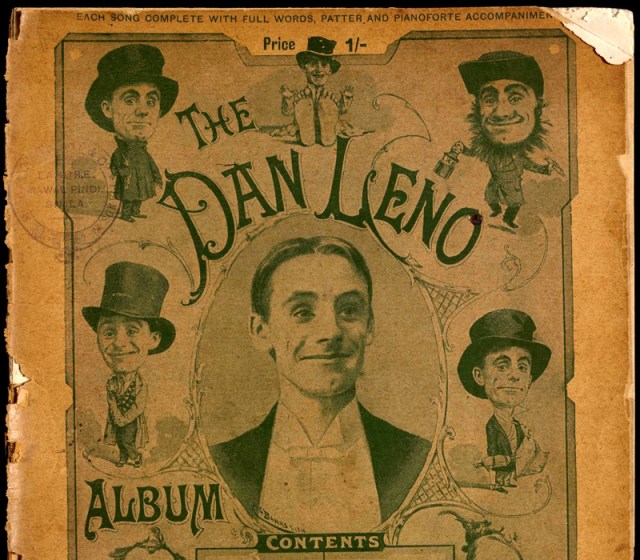
Dan Leno was a music hall comedian famed for his bawdy songs and drag routines. Author Peter Ackroyd wrote a 1994 murder mystery novel set in Victorian London, Dan Leno and the Limehouse Golem. The book’s fictional serial killer, a menace in the vein of Jack the Ripper, is named for the Limehouse district of Tower Hamlets. Though it was pure fiction, Ackroyd’s novel starred a number of historical figures including Dan Leno and Karl Marx. It was published in the United States as The Trial of Elizabeth Cree and adapted into a 2017 film, The Limehouse Golem. Suggs cites the psychogeographic approach of Ackroyd’s London: The Biography as an influence in his conception of “The Liberty of Norton Folgate.”
“Have a banana” (4:23)
“Let’s All Go Down the Strand” was a massively popular 1910 music hall song about having a night out on the Strand, a lively thoroughfare about 3 miles west of Norton Folgate. An ad-libbed audience singalong line got permanently tacked onto the chorus: “Let’s all go down the Strand, have a banana!” (much like various additions to “Sweet Caroline” popularized by American sports crowds). “Have a banana” has become an emblematic Cockney catchphrase much favored in the Suggs repertoire of stage patter.

