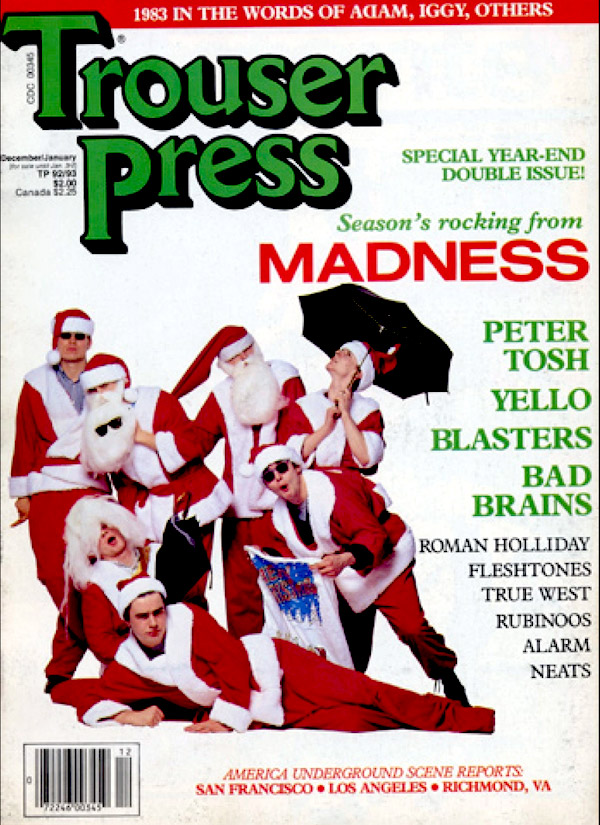
Trouser Press was a legendary U.S. alternative rock magazine published from 1974 to 1984, perhaps best known for its comprehensive Trouser Press Record Guide books. The following is a fantastic article by Jim Green that ran as the cover feature in the magazine’s penultimate issue dated December 1983/January 1984.
This was the single most memorable and important piece of journalism I read on Madness in my first year as a fan. It taught me a lot of the fundamentals of the Madness backstory (how they got their name, the 2 Tone connection, Carl’s evolving role) and gave a peek into how the sausage of the Geffen U.S. album was made (how traumatizing for Suggs to spit “I don’t like it”!). This was the first time I ever heard of their “current British single, ‘Wings of a Dove,’” many long months before I would actually hear the song. And in retrospect, how amusing indeed to see young Suggs decry the horrific notion of a Madness concept album with 14-minute songs. So please enjoy this fine Trouser Press profile, in its transience and in its permanence…
The transatlantic telephone line is dominated by the muffled distortion and hiss common to calls made across a thousand leagues of water; the voice at the other end also cuts off intermittently for split-second intervals. At one point, though, the speaker obviously pauses, as if to gather his thoughts on a subject he rarely discusses, at least not with the press.
‘‘The image of the band is itself almost as strong as the music, if not more memorable, to the average person,” says Graham McPherson. He is referring to Madness, the group in which he is lead vocalist (and, true to form, in which role he is far better known as “Suggs”).
“I don’t know if it’s right or not,” he continues hesitantly, “but musically we’ve been looked on as something instant, not really worthy of analysis.”
Nobody would argue that, least of all McPherson’s bandmates – until the release of the septet’s fourth British album, The Rise and Fall. Madness has moved into new musical and lyrical ground, with the fullest realization of their capabilities to date. Yet the record incurred critical brickbats from the British music press, which characterized it as depressing, and – unkindest cut of all? – “said you couldn’t put most of the songs from it on the jukebox.”
What a switch from the days when Madness was branded too frivolous and lacking in the “socially relevant” virtues of the other outfits with which it was lumped: Selecter, the Beat and the Specials. (The last were the so-called vanguard of neo-ska and proprietors of the 2 Tone label on which the others got their starts.) But Madness has rarely received comment from the Britpress, positive or negative, that hasn’t been based on one prejudgment or another.
That the group suddenly matured isn’t, in the members’ own eyes, deserving of celebration by the press. Nor do they seek the critical scrutiny and interpretation inflicted on artists like Elvis Costello or even the Jam. They just want a fair shake.
If McPherson, bassist Mark Bedford and guitarist Chris Foreman (the latter two available to chat during this summer’s US tour) are representative of their bandmates, one of Madness’s most salient characteristics is a distinct lack of self-consciousness. Madness most likely would have entered the 2 Tone graveyard long ago if they’d been more calculating than what they’ve always been: a bunch of friends who like making music together.
Mark Bedford: “If anything, we’re more influenced by outside sources now than when we started. Back then” – when they were mostly in their late teens – “we, like most kids, thought we knew it all; no-one could tell us anything.”
When Madness started, as the North London Invaders in 1978, there was no “movement” or trend. The band did what they enjoyed, even if few pubs encouraged them.
Another band called the Invaders (from West Yorkshire) staked a claim on the name, necessitating a switch. No one was satisfied with Morris & the Minors (a pun on a British automobile). Then Foreman suggested rechristening the group after one of their songs. As a jokey example he mentioned “Madness”; Prince Buster’s ’60s ska hit was a keynote of their set.
To Foreman’s dismay, the others leapt on it at once. “I didn’t like it,” he says. “I thought it was the kind of thing for an Alice Cooper-type band. But it stuck.”
McPherson now is bemused by the group’s youthfully naive élan in those days. “Like anybody, you don’t really imagine or realize that you’ll be a great success. We always knew, when we were young, that anything we did would be brilliant. Every time we played we expected everyone to go mad, but it didn’t go beyond an immediate enthusiasm for impressing people, as opposed to becoming nationally successful.”
In early 1979 the Specials created 2 Tone and garnered lots of attention. When word got out that they were looking for other groups to put on their label, Madness jumped at the chance. “We sent them a cassette – a rehearsal tape, really,” Foreman says, grimacing.
“Jerry Dammers [the head Special] still has it!” Bedford laughs. “He told me he still listens to it once in a while and has a laugh.”
Still, Dammers and company heard something of merit in it. By September, Madness was enjoying its first bit with its tribute to Buster, “The Prince.”
“We weren’t mugs,” Foreman asserts. “We wanted to get an album out right away.”
“We wanted to do it with 2 Tone,” Bedford adds, “but [the Specials] only had money enough to do their own album.”
Label shopping resulted in their signing to Stiff. An LP, One Step Beyond, was quickly recorded and followed its namesake single into the UK Top 10; the album went platinum during its 64-week chart residency.
Other bit singles followed. Madness’s albums sold even better than most of their 45s, but English pundits jeered the group for being a “singles band” – as if that somehow cheapened the success. Image problems persisted. Madness suffered in the aforementioned comparisons with their former 2 Tone mates (or, for that matter, whichever “serious” new world-beaters were current press favorites).
“We never said, ‘We’re a ska band,’” Foreman claims. “We never put those limits on what we were doing.”
“That’s musical suicide, sooner or later,” Bedford says.
“Other people lumped us into that but we didn’t mind; we knew what we could do,” Foreman adds. “Calling our music the ‘Nutty Sound’ was a way to avoid categorizing ourselves. ‘Nutty’ was just a word Lee [saxman Thompson] used a lot, and someone picked up on it.”
The “Nutty Boys” might have smacked all too much of bubblegum-style merchandising, but even skeptics found it hard not to be taken in by Madness’s wacky antics in front of movie or video cameras. The group released a semi-autobiographical feature film, Take It or Leave It, in October, 1981, and then Complete Madness, a compendium of videos with added linkage and a pair of their Japanese TV commercials thrown in for good measure. And they remained overwhelmingly popular in the UK.
What could be wrong? Gradually, band members got married – notably McPherson to songstress Bette Bright, and drummer Dan “Woody” Woodgate to ex-Mo-dettes bassist Jane Crockford – and started families. But something was brewing.
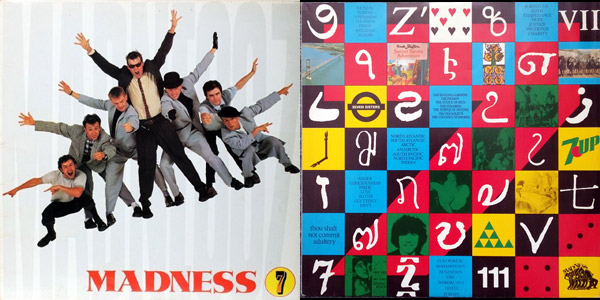
Bedford admits the marriages have crimped Madness’s former camaraderie. And he and Foreman are both less than pleased with the band’s third album, Seven (despite its spawning “House of Fun,” Madness’s first Number One single).
McPherson remembers the situation more clearly: “I was satisfied with Seven, but the others weren’t. We didn’t have the best feeling when we recorded it, in Nassau in the Bahamas; I think we were pressin’ down there, which was very strange.
“It started feeling very professional. That side of things was becoming more prevalent than with the previous two albums, where it was pure luck we were there at all.
“Clive [Langer] and Alan [Winstanley], our producers all along, became scapegoats since they were in control of the proceedings.
“After we got back to London we were thinking of trying other producers. We met Trevor Horn, whom no one got along with. It made us realize how good Clive and Alan are as communicators, apart from everything else. It brought us closer together again.”
Madness then created their best album by far. What made the difference?Just a better atmosphere while it was being recorded?
Bedford and Foreman mention that the band’s working up different arrangements of the same number had a key effect. McPherson puts that new (for Madness) technique into a larger context.
“I think we realized that maybe we had been restricting ourselves, just like any bunch of kids will do. It’s like we weren’t ‘allowed’ to do certain things; none of us would have grown a beard, for instance, and musically it was probably the same. Certain things were ‘uncool,’ like to do introspective stuff. The Rise and Fall was generally more thought out. It’s the first album we’ve made that’s an album, not a collection of songs.”
Indeed. Would you believe a Madness concept album?
“It was gonna be about the rise and fall of a normal person in a particular area that was falling into bad times. ‘Rise and Fall,’ ‘Primrose Hill,’ ‘Sunday Morning’ and ‘Blue Skinned Beast’ were all linked together. But as other songs started to be written, it kind of lost its way. We realized you had to write songs to fill in bits of the story, to keep it moving, but that they might not be very good or able to stand on their own.” McPherson sighs at the thought of “14-minute songs” and such – heaven forfend!
The way the album jelled reveals the vital interaction of Madness’s members. Foreman and keyboardist Mike Barson have long been the songwriting mainstays as well as musical arrangers; Bedford, who’s now writing less, is getting into technical aspects.
“I saw him reading a technical book on engineering,” McPherson says, “and he’s produced singles by two bands, Bonsai Forest and Strawberry Switchblade. Now at least one of us understands what’s going on at that end of things.”
“Woody docs the sleeping for the band,” Bedford jokes, while pointing out that Woodgate did write “Sunday Morning.” McPherson mentions that everyone has taken a more active interest in writing – collaborating more than ever – and arranging.
“That’s part of the reason we’ve stayed together,” he explains. “There’s no pressure on any one person to think of a concept or do all the songs.”
The piece of the Madness puzzle that’s fallen into place is vocalist and trumpet player Carl Smyth – best remembered by early American fans of the group as the zany seventh member, “Chas Smash.”
Smyth got involved with Madness as a friend whose dance antics and vocal hijinks (he’s the voice on “One Step Beyond”) were worked into the group. But he seemed something of a fifth (or in this case seventh) wheel; he doesn’t appear on the cover of the first album.
“There was a funny period just after One Step Beyond that Carl didn’t have much to do with,” McPherson says. “He was a member of the band, but he wasn’t really involved with anybody else – particularly me, because we’re both singers. We talked about it between ourselves, and it must have been strange for him; I think he felt he was sort of outside us, yet felt changing that would be pushing me out. He didn’t push his position ’cause he didn’t know what it was. But we decided that whoever had the right thing, be it words or music or singing, we’d do whatever seemed right.”
Smyth’s enthusiasm is evidently catching. “He’ll have a million ideas when we start talking about videos,” McPherson says, “another million when we’re getting things together for it, and when we’re actually doing it he’ll have a million more. It’s like he had something bottled up in him and suddenly the cork sprang out. He’s brilliant. We probably wouldn’t be here if he wasn’t like he was, because out of every million ideas come 10 really good ones.
“And he’s always thinking of dance routines we can do, or whatever. If things start flagging a bit, he’ll pick us up.”
Now known within the group as “Mr. Bosh,” Smyth reverted to his given name for songwriting credits. Since co-writing “Cardiac Arrest,” a hit single on Seven, Smyth has made several important contributions – notably co-writing “Our House” (“Carl lives in one very much like that,” Foreman says), “Tomorrow’s Just Another Day” and the current British single, “Wings of a Dove.”
Madness fans got a bonus with the British single version of “Tomorrow’s Just Another Day”: a guest lead vocal by Elvis Costello.
“I’d heard an old rockabilly song,” McPherson says, “which started out with a bluesy version, then faded out and back in to a rocked-up arrangement. I thought it’d be great to have something like that on ‘Tomorrow’s Just Another Day’ – an arrangement that sounded old and bluesy, just 20 seconds at the beginning of the song, and then cross-fading into the newer version, which we’d already done.
“The backing track was cut, slowed down a bit and quite good. But I couldn’t come to grips with real singing. So Carl had a go; he did a good version, jazzed up a bit in the phrasing, but it still didn’t sound quite right.
“By that time we’d finished the album and still had this backing track. Clive was soon going to be producing the new Elvis Costello album, and I think Chris suggested he ask Elvis to try it. He was really good; came in, did it and left. If he hadn’t, we’d still have that backing track sitting around! I think it was one of the best vocals he’s ever done.” Perhaps in deference to Madness, Costello sang with a British accent, which he also tried out on Punch the Clock.
In the US, Sire Records had released One Step Beyond and its follow-up, Absolutely; both albums promptly died the death. Sire didn’t bother with Seven, but Madness, hugely successful everywhere else, wasn’t too concerned. “We didn’t tum our back on America, really,” Foreman says. “We just kind of forgot about it.”
According to Geffen Records A&R man Danny Heaps, however, US labels didn’t forget about Madness – especially as the group racked up hit after hit in England and Europe. In early 1983, Heaps says, Madness approached Geffen – a hot new company that had just started the last time the band had an American release.
“They were a logical signing. Remember, at that time Dexy’s was number one here. And you know, that stuff about Madness being ‘too English’ for the US is nonsense.”
“We picked Geffen for the same reasons we signed with Stiff,” Bedford says, “because of the people we talked to. They accepted us for what we are – not saying, ‘You’re great but you’ll have to do this and you ought to do that.”‘
Geffen released Madness, a compilation drawn mostly from The Rise and Fall but digging as far back as the first album.
“I don’t like it,” McPherson states. “It’s a scrapbook, not an album.”
Foreman is more philosophic. “Programming the album that way is, well, the way things are done for the US. I didn’t used to feel this way about it, but now I realize it has to be.”
Heaps argues that Geffen’s track selection, “instead of putting out all of The Rise and Fall, was purely commercial logic. The stuff from Seven, which includes singles, has never been out here – and ‘Night Boat to Cairo’ [from One Step Beyond] is just a track someone in the company really wanted on there. We wanted to put on ‘Madness’ or ‘The Prince,’ but the group would allow only so much of our delving into the past.”
The “commercial logic” paid off. Madness has sold over 200,000 copies, and spun off two hit singles: the Top 10 “Our House” and a version of Labi Siffre’s “It Must Be Love.”
Future plans? Typically, McPherson chuckles and quips that he’s anxious to “have some of the stew that my beautiful wife’s knockin’ up on the cooker.” More seriously, he’s looking ahead to the next Madness album. Recording began last spring, before an American tour, and resumed this autumn.
“Before we recorded The Rise and Fall,’’ Bedford says, “the mood of the country was pretty grey.” He mentions Britain’s economy and the Falklands war, referred to in “Blue Skinned Beast” – dead soldiers were put into blue body bags. In contrast, Madness’s spring studio session were much more uptempo.
“We’re looking out for our more introspective tendencies,’’ McPherson says, “even though we’re not sure we’ve been going into them that heavily, so we can balance that with our more flamboyant side.”
Madness getting self-conscious? Losing artistic innocence? Maybe… and maybe not. McPherson still believes in group dynamics.
“The Rise and Fall succeeded because there was so much collaboration. Everyone had to stay interested, or we wouldn’t know what was going on the record! People change and grow together when they get so intensely involved. I think we were all in the same groove, the same vein, when we made that record.”
That’s what he thinks makes Madness yield up its best work: democratic anarchy.
Article © 1983 Trouser Press LLC