A Star-Spangled Mashup Gallery of Seven Honorary Yankee Doodle Dandies



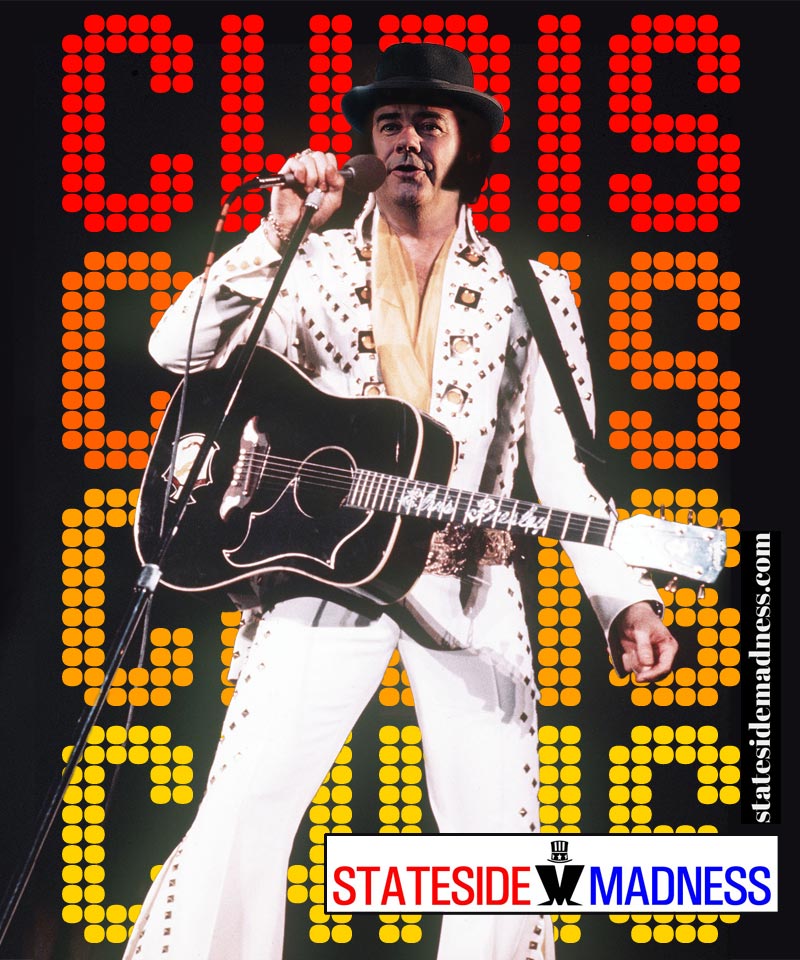




The following is an excerpt from the 1982 book A Brief Case History of Madness by Mark Williams. This slim, magazine-like 32-page volume was my first Madness book, ordered out of the back pages of Star Hits or some such. The copyright page lists both U.K. and U.S. publishing details, and retail prices of £1.95 and $3.95 both appear on the back, so I suppose this was an American publication rather than an import.
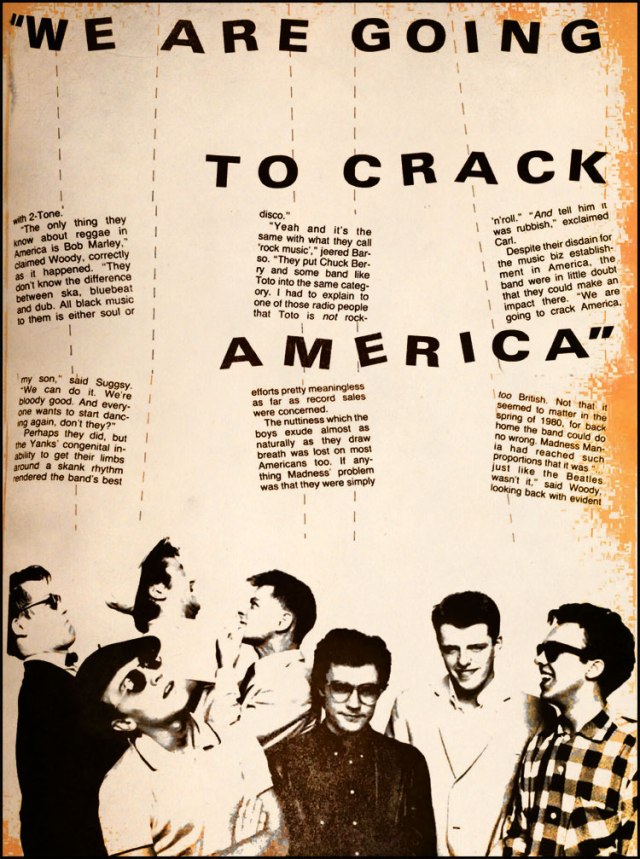
In this time capsule just before the advent of “Our House,” the band discuss their early impressions of America (including our general musical ignorance over here – can’t really argue that!), and Suggs self-assuredly prognosticates their eventual Stateside breakthrough.
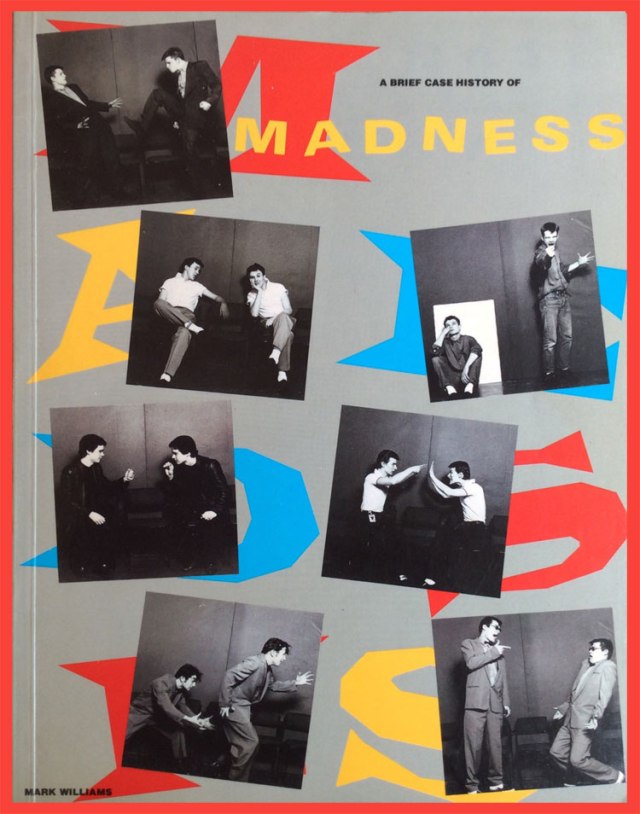
[In March 1980] Stiff released the first Madness EP, Work, Rest & Play, with a new version of their rollicking stage favourite, a one-verse song (or semi-instrumental) called Night Boat to Cairo. The EP went to number six in the single charts and Madness went to America.
It was in fact their second trip to the States. They’d adventurously gone there off their own bat the previous year, just after they’d signed up with the American label, Sire Records, who had no product to promote at the time. “We wanted to beat the Specials to America,” quipped Woody. In ’79 they’d been playing small clubs for a few hundred dollars a throw but the Anglophile faction amongst America’s teenagers had not been slow off the mark, and now they were filling ballrooms with hordes of op-art garbed punters who still identified Madness with 2-Tone.
“The only thing they know about reggae in America is Bob Marley,” claimed Woody, correctly as it happened. “They don’t know the difference between ska, bluebeat and dub. All black music to them is either soul or disco.”
“Yeah, and it’s the same with what they call ‘rock music,’” jeered Barso. “They put Chuck Berry and some band like Toto in the same category. I had to explain to one of those radio people that Toto is not rock ’n’ roll.”
“And tell him it was rubbish,” exclaimed Carl.
Despite their disdain for the music biz establishment in America, the band were in little doubt that they could make an impact there. “We are going to crack America, my son,” said Suggsy. “We can do it. We’re bloody good. And everyone wants to start dancing again, don’t they?”
Perhaps they did, but the Yanks’ congenital inability to get their limbs around a skank rhythm rendered the band’s best efforts meaningless as far as record sales were concerned.
The nuttiness which the boys exude almost as naturally as they draw breath was lost on most Americans too. If anything Madness’ problem was that they were simply too British. Not that it seemed to matter in the spring of 1980, for back home the band could do no wrong. Madness Mania had reached such proportions that it was “…just like the Beatles, wasn’t it?” said Woody, looking back with evident disbelief. And it was.
After cranking out hit after hit in the UK for about four years, Madness finally cracked the fickle American market in 1983 with “Our House.” That classic track took the band into the U.S. Top 10 and served as the primary entry point for their American fans, myself included. But I have to admit, I wasn’t convinced to jump aboard the nutty train right away.
I can recall with great clarity when I first heard ”Our House,” as a wee lad of 13. At the time my favorite band was Men at Work, and as a younger kid I was into Kiss and The B-52s. I was home alone after school, sitting at the kitchen table doing homework with the radio on. This very peculiar song came blasting out, a torrent of pounding piano and bombastic brass and swirling strings. No arena rock guitar riffs or electronic synth beats to be found. What we had here was something foreign, in more ways than one.
At first I thought it must be an advertisement. Some kind of real estate insurance jingle? An Olde-England flavored ditty for Merry Maids? A public service announcement on quality family time from the Church of Jesus Christ of Latter-Day Saints? But no, this jaunty little tune kept rollicking on and on past the :30 mark. It was no commercial… it was an actual music-song-type song, of some hitherto unknown variety.
I put my pencil down and stuck my head into the radio speaker to try and figure out what the heck I was listening to. So it’s this British guy urgently waxing poetic about his family unit and the daily routine activities transpiring in their domicile. How weird is that? I distinctly remember being confused about the chorus, which to me sounded like “Ah, house.” I reasoned that the nostalgia-ridden singer was wistfully addressing his old childhood home by name: “Ah, house. Ah, room. Ah, cow jumping over the moon.” In the middle of “Ah” street?
This moment left an impression on me, obviously. But I was not an instant fan. It was more like I’d been struck by a hit-and-run ice cream truck that went speeding away lickety-split with its jolly chime echoing in the distance. What in the world was that? The music was kinda catchy, but the vocal style and general cutesiness put me off a bit. My American Bandstand hot take: it’s got a good beat and you can dance to it, but it sounds like children’s music. I’d just become a teenager, after all, at that age when you’re out to prove you’re not a kid anymore. To those ears, “Ah, House” sounded childish next to the likes of The Police and Duran Duran, with their PG-rated songs of sex and obsession and adulting.
It wasn’t long after this first exposure that I gave the daft alien melody another round of scrutiny. And this time my judgment was far more charitable, thanks to the visionary genius of one Mr. Dave Robinson. Yes, it was the music video that won me over.
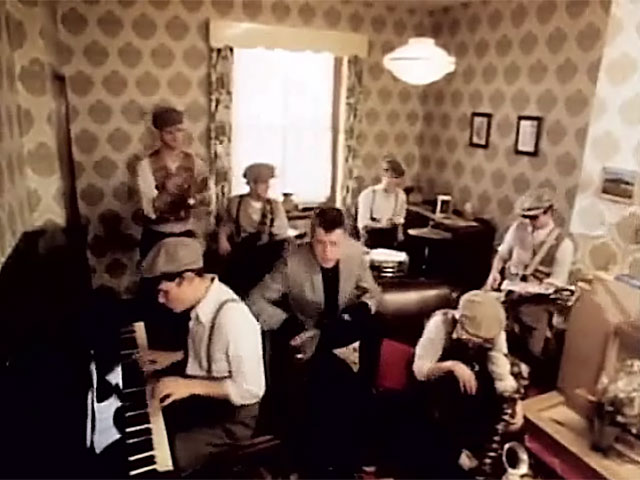
MTV doesn’t get the credit, because our backwater North Carolina cable provider didn’t add the channel until a year or so later. For music videos I depended on Night Tracks on SuperStation TBS, Night Flight on USA, and Friday Night Videos on NBC. It would have been on one of these beloved programs that I first saw the video for that oddball British song. By virtue of the credit captions, I learned that the name of the band was Madness, and of course they weren’t singing “Ah, House” at all. “Our” did make a lot more sense, didn’t it?
More to the point, the entire song made a lot more sense, given context by that completely brilliant video. Putting faces to the odd noises coming out of the radio, I suddenly got a better sense of who these guys were. And man, they were so cool! They were silly and clowning around, sure, but Madness no longer seemed juvenile once you got a look at ’em. Nor were they preening fancy lads like A Flock of Seagulls or Kajagoogoo. There was a grubby and working-class edge to their bouncy sound. Their humor shared points of reference with Monty Python, per the hirsute sax player in drag playing the pepperpot housewife, and the lot of them lounging in a hot tub with knotted Gumby handkerchiefs on their heads. And that lead singer! Flattop haircut, fingerless black gloves, snazzy gray suit jacket, all those frantic gestures and rubbery facial expressions. He was kind of ugly, but kind of handsome at the same time. Right away he was my favorite member of the group.
The sequence with the guitar solo most clearly crystalized the song’s meaning, moving from boyhood air guitar to Elvis phase to Beatles obsession to new wave rocker in the space of 15 seconds. It’s a song about growing up, and remembering all those things you miss in lots of ways.
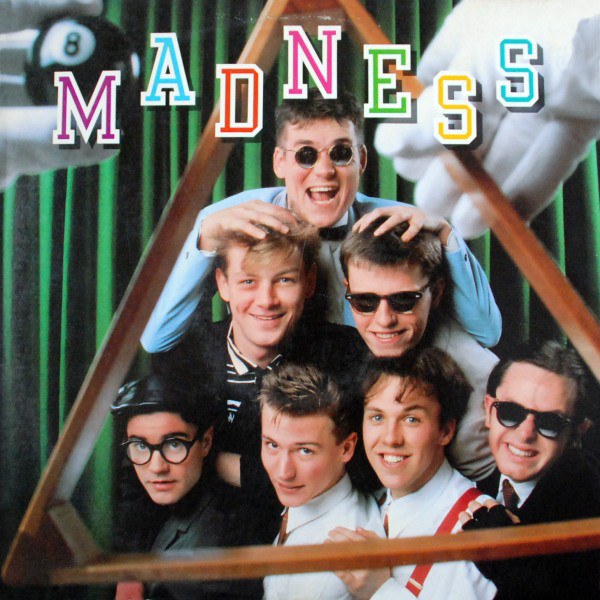
Soon I bought my first Madness “album,” Geffen’s self-titled 1983 U.S. compilation with the billiards cover. Which, as best as I knew, was the band’s debut album, featuring their first hit song. But even that purchase was a complicated decision, because avid music video consumption had got me interested in both Madness and Eurythmics. Finances were limited back then, and I couldn’t just go out and buy two albums (cassette tapes, actually) at the same time like a Rockefeller. After much deliberation I decided Madness was the one for me to risk my allowance on. And yeah, you can probably guess where this is going. It wasn’t love at first listen.

Even though I was sold on how awesome “Our House” was, the other 11 tracks didn’t thrill me. Too much repetition of annoying little phrases (“Close your eyes and count to three… 1-2-3!” “Three cheers, hip hip hip!” “Welcome to the house of fun!”), too many annoying little sound effects (carnival noises, a thumping heartbeat, a foghorn). Again I found myself back in that initial radio-listener position of thinking Madness sounded immature and cringey. Drat it all, how I wished I had spent my precious dollars on Sweet Dreams (Are Made of This) instead!
And once again, it was the music video that made the difference. As I recall, within the same week that I bought the disappointing Madness tape, I saw the video for “It Must Be Love.” Boom. The scales dropped from my eyes and the cotton unplugged from my ears. “It Must Be Love” no longer sounded so syrupy sweet, leavened by jogging undertakers, people in bird and bee costumes, and the guitarist and sax player playing their instruments underwater (swimming “with” a killer whale, for some reason). The lead singer, whose name I learned from the cassette liner notes was G. Suggs McPherson, was even cooler and more charismatic than in the “Our House” video. I’d never felt a real urge to “be” a given pop star before, but I wanted to be Suggs. In this particular case The Buggles were wrong: Video saved the radio star.
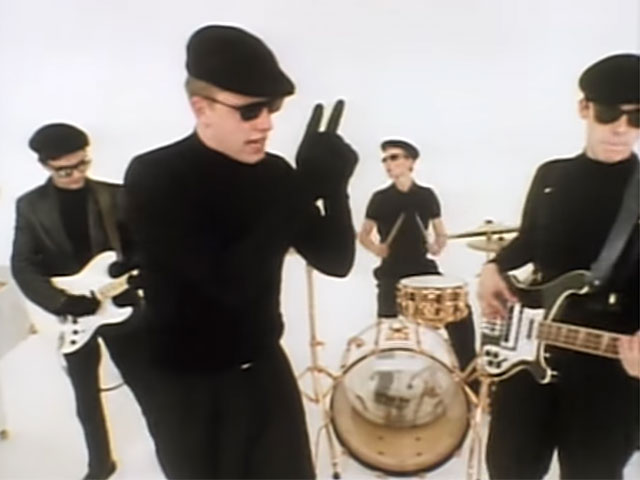
I went back to my Madness tape with renewed interest, incrementally calibrating my sense of this band’s identity and what their music meant. The idiosyncrasies in their sound ceased to seem childish or annoying. There was much to learn about Madness, and I was now an eager student.
When Madness pierced the veil of American pop culture in 1983, the rupture opened only a tiny pinhole for us to gaze through. The view was foggy, distorted and incomplete. I formed false first impressions, and most of my countrymen barely registered any at all prior to that ephemeral pinhole sealing back up. But I heard something and felt something on the other side of that trans-Atlantic barrier, so I clawed open my own damn pinhole with my bare hands. I worked at it, I kept listening, I scoured music magazines for scant precious information, I tracked down their past recordings, I became a loyally devoted fan, and I stretched that pinhole wide enough to climb though and tumble headlong into the realm of Madness. I put in the time and effort, digging to excavate the gold I knew was there beneath the surface.
Suffice to say, I found it. In the middle of “Ah” street.
 Stateside Madness