How many Madness albums have never been released on disc in the U.S.? Which states have they ever played in outside of New York and California? Where did they once share an amazing bill with David Bowie and the Go-Go’s? When were they on Saturday Night Live that one time, and what songs did they play?
Now you can find the answers to these scintillating questions and more on our new U.S. History page here on the SSM blog! We’ve pieced this archival inventory together from various online sources, including Discogs, Seven Ragged Men, Setlist.fm, Concert Archives, Fandom Concerts Wiki, and Madness on TV. It’s far from complete, and may or may not be 100% accurate, so we welcome your additions or corrections. Especially in terms of the concert calendars, there plainly must be a few gaps.
This will be an ongoing project, a living document with updates made as we get better and more comprehensive information. And let’s hope the band’s future holds plenty more U.S. history yet to be written.
As a budding Madness fan in 1983, I was surprised to learn from music magazines that “Our House” was not, in fact, the band’s first hit song. It turned out they had four albums out in the U.K., where they had racked up a whole slew of hits with evocative names like “The Prince” and “Baggy Trousers.” What the what? How come we never heard any of this in America? My archeological mission to excavate that hitherto unknown Madness music was on.
I gleaned from the press articles that their first two albums had been released in the U.S. by Sire Records, who then dropped the band due to poor sales. So I knew those should exist somewhere within reach. The Tape Shack and Sky City in my hometown would never stock anything so obscure, though. I turned to Camelot Music at Blue Ridge Mall in nearby Hendersonville, NC – at that time surely the biggest and most awesome record store in western North Carolina. This place had everything, with rows upon rows flush with punk, new wave and underground rock, from Black Flag to Bauhaus, from Leonard Cohen to Siouxsie and the Banshees. This Camelot was not at all a silly place, and I spent many a happy hour browsing its wares and testing my parents’ patience. In later years I’ve shopped at major chain record stores in Los Angeles and London that were no more spectacular. It goes without saying that Camelot Music is long since defunct.
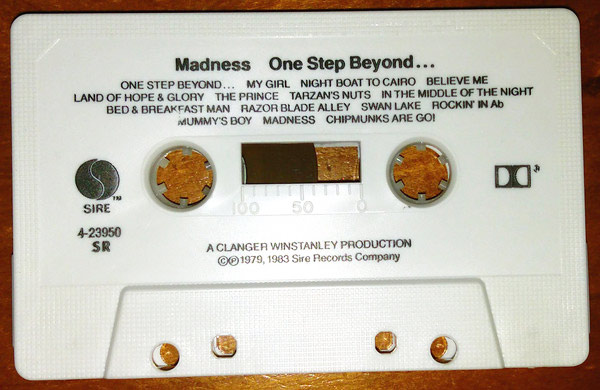
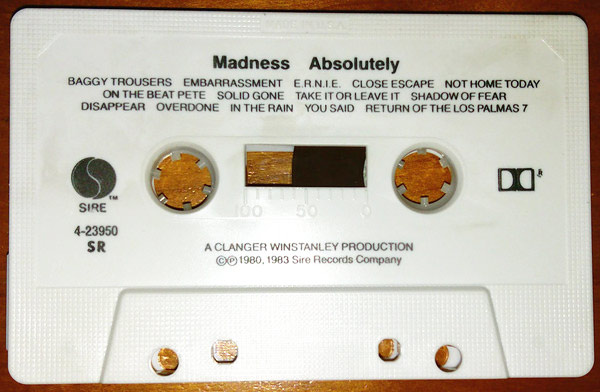
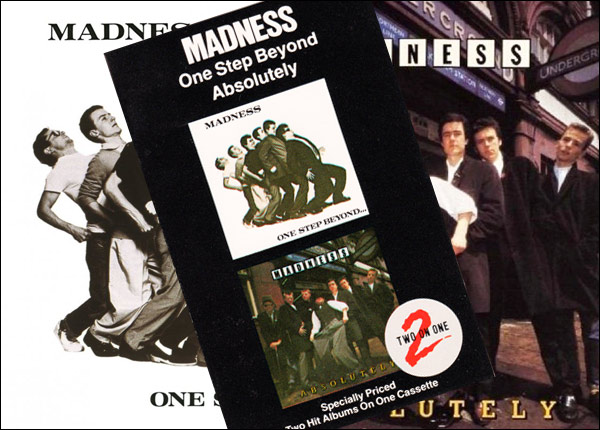
But back on that one cherished day I maneuvered through the “M” section of Camelot’s cassette bins, and there to my wonderment I spotted One Step Beyond and Absolutely. Both on one tape.
Putting two complete albums on one cassette was a moderately popular trend at the height of the cassette era. The labels must have noticed how music lovers were recording two albums on 90-minute blank tapes, which was especially attractive with the advent of mobile music via the Sony Walkman. Warner Music Group (including Elektra, Atlantic and Sire) spearheaded the movement with their distinctive “Two on One” branding. The value proposition offered consumers double the product for a cost of one or two dollars more than a standard cassette. Some tapes combined two big hit records, while others disappointingly paired one classic with a lackluster later release. That’s marketing for ya.
Now in the case of Madness, here was a minor British act that Sire had taken a gamble on and didn’t pan out. The individual releases of One Step Beyond (1979) and Absolutely (1980) were big flops, and the combo cassette’s 1983 release date indicates it appeared only in response the success of “Our House.” This improbable duplex, nonexistent in the U.K., was devised for the sake of curious Stateside risk-takers like me.
And oh man, what a blessed discovery it was. Playing that tape in Daddy’s pickup truck on the ride home was nothing like my first exposure to Madness, when I grappled with whether or why I should embrace the nutty sound. Diving into both One Step Beyond and Absolutely all at once, I loved them all at once. I had drawn a double-decker Excalibur aloft from the enchanted Camelot stone.
I think the only hesitation I had at first was the rawness of the vocals, in comparison with Suggs’ relatively silky crooning on “Our House” and “It Must Be Love.” In fact, I was under the false impression that all of the singing on the first two albums was the younger 1979-80 Suggs – it took me a while to figure out which tracks were sung by Carl or Lee. To be fair, those three north London voices sounded pretty much the same to a 13-year-old American kid. Regardless, the vocal stylings grew on me soon enough, and the punchy zip of the music had me captivated from the bellowing call to attention that opened the first album to the quiet “Good night” at the close of the second one. The Geffen Madness compilation sparked my interest in the band, but it was this anthology of an older vintage that confirmed me a lifelong fan.
One Step Beyond and Absolutely have been reviewed and rated ad infinitum, and anyone reading this probably knows what they sound like. I just ask your indulgence to paint the picture of how this double cassette indelibly impressed my younger self. The only song on it that I knew previously was “Night Boat to Cairo” (a remix of which was included on the Geffen album). The other 28 tracks were entirely new, unfamiliar, and at times downright koo-koo, and yet I felt connected to them right away.
The sheer amount of musical invention was dizzying. One thing I quickly grasped was that Madness had an instantly identifiable sound, and yet no two songs sounded the same. They had a rock-solid, muscular rhythm section, and melodies anchored by deft piano (or non-synth organ), all punctuated with flinty guitar and boisterous saxophone, topped off with wry vocals whose charm compensated for technical skill. Yet within this formula, One Step Beyond and Absolutely presented a sumptuous buffet of variations. In addition to your standard pop music themes of heartbreak, nostalgia and good-time partying, there were songs about deviant behavior, racial prejudice and social anxiety.
From the magazine articles I learned that Madness’s style of music was something called ska. Even though it would take me a long time to learn that only a couple of their earliest songs bore any legitimate resemblance to real Jamaican ska, it was plain even to uninformed ears that there was more than one musical genre on display here. By turns the songs incorporated R&B, Motown, oldies rock & roll, dance hall, classical, and TV sitcom theme stylings just as much as ska. And such off-kilter song construction, where the chorus is semi-optional, or you might get a scrap of one verse or some random shouting tacked onto a wild instrumental. One Step Beyond and Absolutely were packed with fascinating contradictions. Any given track could be both cheerful and somber. Both simple and complex. Both silly and profound. Both stupid and clever.
With mind fully blown, I delighted in listening to the double-dose crash course in Madness over and over and over. I loved to lie in my bedroom with a boom box resting on my chest, cranking Madness into my face for the sort of analytical close listening that music connoisseurs would typically do with headphones. I fondly recall studying “The Prince” like this, mentally isolating each of the main instruments as well as all the little bloooorps and swishy-swishies and tok-toks that accrete in intricate layers as the track progresses. This tape was my Sgt. Pepper, my Led Zeppelin II, my Dark Side of the Moon.
Speaking of favorite albums, it’s worthy of note that all of the most significant and influential music of my teenage years came on double-length cassettes. One Step Beyond / Absolutely (1979/1980), The Jam’s greatest hits Snap! (1983), Minutemen’s epic masterpiece Double Nickels on the Dime (1984) and their compendium My First Bells (1985), the Skatalites’ live reunion Stretching Out (1987). A double album packed with great songs is inherently more listenable, since you can play it more without getting tired of it. And it plays right into a obsessive personality like mine: when I find something I love, I latch on with a rapacious appetite for mass quantities of it. You might logically argue I would have formed the same appreciation for One Step Beyond and Absolutely if I had bought them on individual cassettes. But I don’t think so. Being bound together in a single unit magnified the Madness energy exponentially and consecrated a holy talisman that felt less like two records and more like one big sprawling opus.
One thing’s for sure: any economic advantage I gained from buying the two albums on one cassette didn’t hold up in the long run, since I kept wearing it out mercilessly. I played it so much that the tape crinkled and started warbling like a broadcast from the innards of a dyspeptic whale. I suppose the two-on-ones may have used a thinner and less durable kind of tape in order to accommodate the longer running time. I went through three copies of the cassette: the original, a second I special-ordered from the local Tape Shack, and a third as a Christmas gift I requested from my sister. The final verse in “Believe Me” always reminds me of that holiday season – “Christmas comes but once a year, it’s a time of love and cheer.” With my One Step Beyond / Absolutely Mark III,I finally got wise and started making listening copies to leave the master tape in mint condition. This method served my rigorous demands until compact discs appeared.
Which brings us to the ultimate obsolescence that befell the beloved instrument of my Madhead education. Two-on-one CDs were never much of a thing, predictable given the traditional 74-minute capacity of the format. I have a nice edition of The Jam’s All Mod Cons and Sound Affects on one disc, as well as the Minutemen Post-Mersh collections, and how sweet it would be to own an official One Step Beyond / Absolutely CD, if the combined runtime weren’t a bit too long. Though I welcomed the superior digital audio (and ruggedness) of the compact disc, it was bittersweet to have One Step Beyond and Absolutely rent in twain by the grim march of technology. Still, my mind will always anticipate that school bell’s ring immediately after the Chipmunks finish their roar… and this, my friends, is precisely what iTunes playlists are made for.
Fans would generally say The Liberty of Norton Folgate was the first “double album” Madness ever released. Yeah, but not in my book.
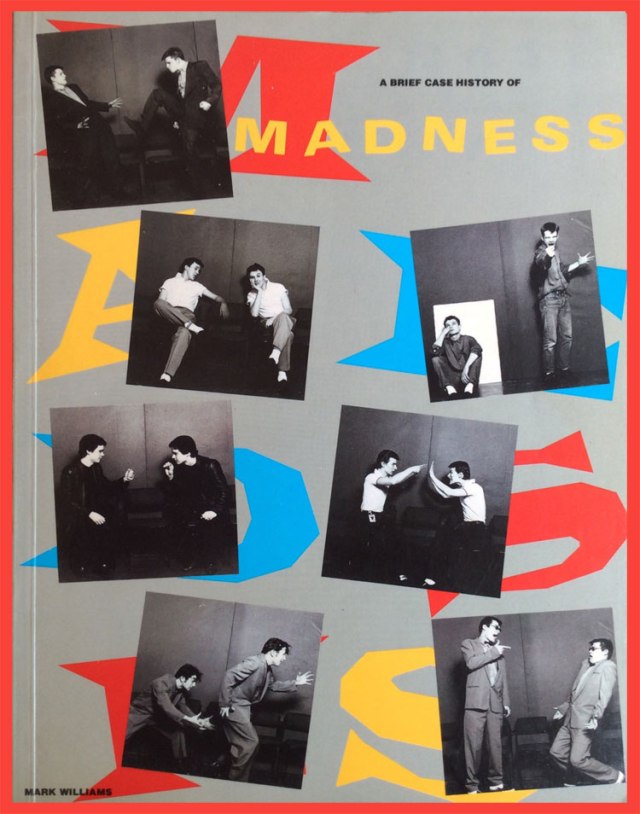
The following is an excerpt from the 1982 book A Brief Case History of Madness by Mark Williams. This slim, magazine-like 32-page volume was my first Madness book, ordered out of the back pages of Star Hits or some such. The copyright page lists both U.K. and U.S. publishing details, and retail prices of £1.95 and $3.95 both appear on the back, so I suppose this was an American publication rather than an import.
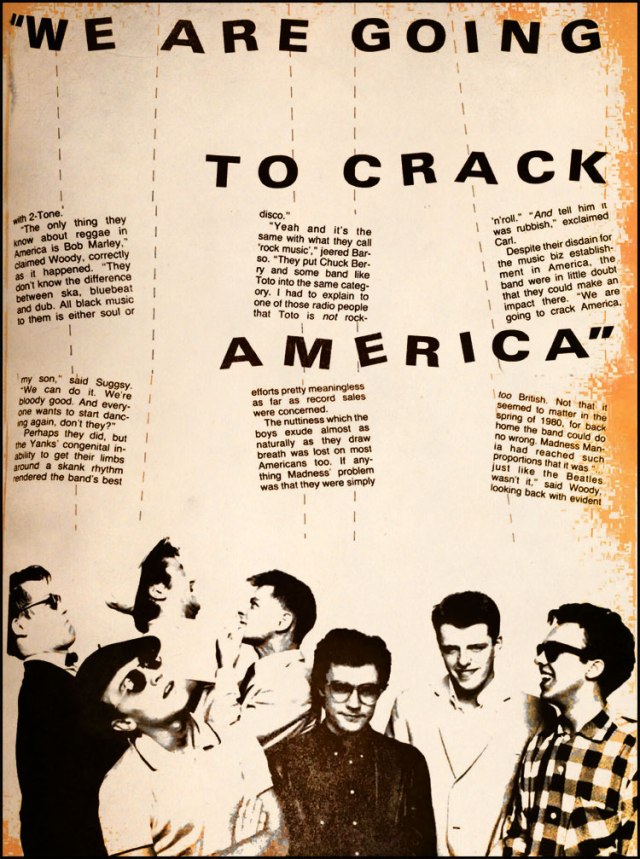
In this time capsule just before the advent of “Our House,” the band discuss their early impressions of America (including our general musical ignorance over here – can’t really argue that!), and Suggs self-assuredly prognosticates their eventual Stateside breakthrough.
[In March 1980] Stiff released the first Madness EP, Work, Rest & Play, with a new version of their rollicking stage favourite, a one-verse song (or semi-instrumental) called Night Boat to Cairo. The EP went to number six in the single charts and Madness went to America.
It was in fact their second trip to the States. They’d adventurously gone there off their own bat the previous year, just after they’d signed up with the American label, Sire Records, who had no product to promote at the time. “We wanted to beat the Specials to America,” quipped Woody. In ’79 they’d been playing small clubs for a few hundred dollars a throw but the Anglophile faction amongst America’s teenagers had not been slow off the mark, and now they were filling ballrooms with hordes of op-art garbed punters who still identified Madness with 2-Tone.
“The only thing they know about reggae in America is Bob Marley,” claimed Woody, correctly as it happened. “They don’t know the difference between ska, bluebeat and dub. All black music to them is either soul or disco.”
“Yeah, and it’s the same with what they call ‘rock music,’” jeered Barso. “They put Chuck Berry and some band like Toto in the same category. I had to explain to one of those radio people that Toto is not rock ’n’ roll.”
“And tell him it was rubbish,” exclaimed Carl.
Despite their disdain for the music biz establishment in America, the band were in little doubt that they could make an impact there. “We are going to crack America, my son,” said Suggsy. “We can do it. We’re bloody good. And everyone wants to start dancing again, don’t they?”
Perhaps they did, but the Yanks’ congenital inability to get their limbs around a skank rhythm rendered the band’s best efforts meaningless as far as record sales were concerned.
The nuttiness which the boys exude almost as naturally as they draw breath was lost on most Americans too. If anything Madness’ problem was that they were simply too British. Not that it seemed to matter in the spring of 1980, for back home the band could do no wrong. Madness Mania had reached such proportions that it was “…just like the Beatles, wasn’t it?” said Woody, looking back with evident disbelief. And it was.
The entire text of A Brief Case History of Madness is pasted up in askew little postage-stamp squares of type. Because it’s more MAD that way, evidently.
(Or, How I Learned to Stop Worrying and Love Madness)
After cranking out hit after hit in the UK for about four years, Madness finally cracked the fickle American market in 1983 with “Our House.” That classic track took the band into the U.S. Top 10 and served as the primary entry point for their American fans, myself included. But I have to admit, I wasn’t convinced to jump aboard the nutty train right away.
I can recall with great clarity when I first heard ”Our House,” as a wee lad of 13. At the time my favorite band was Men at Work, and as a younger kid I was into Kiss and The B-52s. I was home alone after school, sitting at the kitchen table doing homework with the radio on. This very peculiar song came blasting out, a torrent of pounding piano and bombastic brass and swirling strings. No arena rock guitar riffs or electronic synth beats to be found. What we had here was something foreign, in more ways than one.
At first I thought it must be an advertisement. Some kind of real estate insurance jingle? An Olde-England flavored ditty for Merry Maids? A public service announcement on quality family time from the Church of Jesus Christ of Latter-Day Saints? But no, this jaunty little tune kept rollicking on and on past the :30 mark. It was no commercial… it was an actual music-song-type song, of some hitherto unknown variety.
I put my pencil down and stuck my head into the radio speaker to try and figure out what the heck I was listening to. So it’s this British guy urgently waxing poetic about his family unit and the daily routine activities transpiring in their domicile. How weird is that? I distinctly remember being confused about the chorus, which to me sounded like “Ah, house.” I reasoned that the nostalgia-ridden singer was wistfully addressing his old childhood home by name: “Ah, house. Ah, room. Ah, cow jumping over the moon.” In the middle of “Ah” street?
This moment left an impression on me, obviously. But I was not an instant fan. It was more like I’d been struck by a hit-and-run ice cream truck that went speeding away lickety-split with its jolly chime echoing in the distance. What in the world was that? The music was kinda catchy, but the vocal style and general cutesiness put me off a bit. My American Bandstand hot take: it’s got a good beat and you can dance to it, but it sounds like children’s music. I’d just become a teenager, after all, at that age when you’re out to prove you’re not a kid anymore. To those ears, “Ah, House” sounded childish next to the likes of The Police and Duran Duran, with their PG-rated songs of sex and obsession and adulting.
It wasn’t long after this first exposure that I gave the daft alien melody another round of scrutiny. And this time my judgment was far more charitable, thanks to the visionary genius of one Mr. Dave Robinson. Yes, it was the music video that won me over.
MTV doesn’t get the credit, because our backwater North Carolina cable provider didn’t add the channel until a year or so later. For music videos I depended on Night Tracks on SuperStation TBS, Night Flight on USA, and Friday Night Videos on NBC. It would have been on one of these beloved programs that I first saw the video for that oddball British song. By virtue of the credit captions, I learned that the name of the band was Madness, and of course they weren’t singing “Ah, House” at all. “Our” did make a lot more sense, didn’t it?
More to the point, the entire song made a lot more sense, given context by that completely brilliant video. Putting faces to the odd noises coming out of the radio, I suddenly got a better sense of who these guys were. And man, they were so cool! They were silly and clowning around, sure, but Madness no longer seemed juvenile once you got a look at ’em. Nor were they preening fancy lads like A Flock of Seagulls or Kajagoogoo. There was a grubby and working-class edge to their bouncy sound. Their humor shared points of reference with Monty Python, per the hirsute sax player in drag playing the pepperpot housewife, and the lot of them lounging in a hot tub with knotted Gumby handkerchiefs on their heads. And that lead singer! Flattop haircut, fingerless black gloves, snazzy gray suit jacket, all those frantic gestures and rubbery facial expressions. He was kind of ugly, but kind of handsome at the same time. Right away he was my favorite member of the group.
The sequence with the guitar solo most clearly crystalized the song’s meaning, moving from boyhood air guitar to Elvis phase to Beatles obsession to new wave rocker in the space of 15 seconds. It’s a song about growing up, and remembering all those things you miss in lots of ways.
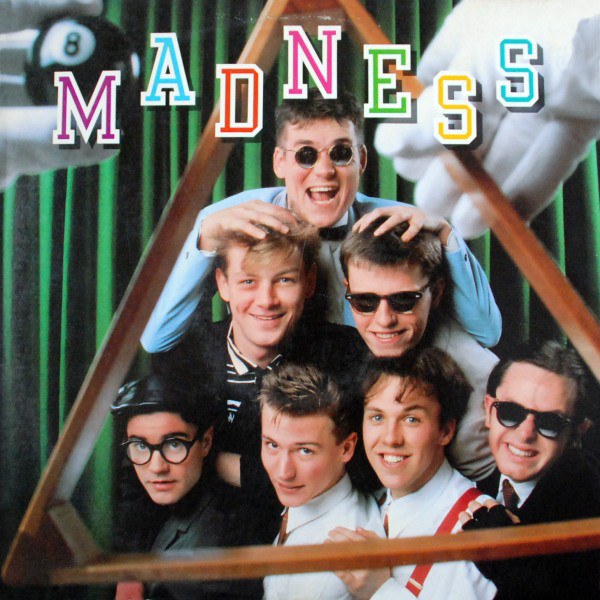
Soon I bought my first Madness “album,” Geffen’s self-titled 1983 U.S. compilation with the billiards cover. Which, as best as I knew, was the band’s debut album, featuring their first hit song. But even that purchase was a complicated decision, because avid music video consumption had got me interested in both Madness and Eurythmics. Finances were limited back then, and I couldn’t just go out and buy two albums (cassette tapes, actually) at the same time like a Rockefeller. After much deliberation I decided Madness was the one for me to risk my allowance on. And yeah, you can probably guess where this is going. It wasn’t love at first listen.
Even though I was sold on how awesome “Our House” was, the other 11 tracks didn’t thrill me. Too much repetition of annoying little phrases (“Close your eyes and count to three… 1-2-3!” “Three cheers, hip hip hip!” “Welcome to the house of fun!”), too many annoying little sound effects (carnival noises, a thumping heartbeat, a foghorn). Again I found myself back in that initial radio-listener position of thinking Madness sounded immature and cringey. Drat it all, how I wished I had spent my precious dollars on Sweet Dreams (Are Made of This) instead!
And once again, it was the music video that made the difference. As I recall, within the same week that I bought the disappointing Madness tape, I saw the video for “It Must Be Love.” Boom. The scales dropped from my eyes and the cotton unplugged from my ears. “It Must Be Love” no longer sounded so syrupy sweet, leavened by jogging undertakers, people in bird and bee costumes, and the guitarist and sax player playing their instruments underwater (swimming “with” a killer whale, for some reason). The lead singer, whose name I learned from the cassette liner notes was G. Suggs McPherson, was even cooler and more charismatic than in the “Our House” video. I’d never felt a real urge to “be” a given pop star before, but I wanted to be Suggs. In this particular case The Buggles were wrong: Video saved the radio star.
I went back to my Madness tape with renewed interest, incrementally calibrating my sense of this band’s identity and what their music meant. The idiosyncrasies in their sound ceased to seem childish or annoying. There was much to learn about Madness, and I was now an eager student.
When Madness pierced the veil of American pop culture in 1983, the rupture opened only a tiny pinhole for us to gaze through. The view was foggy, distorted and incomplete. I formed false first impressions, and most of my countrymen barely registered any at all prior to that ephemeral pinhole sealing back up. But I heard something and felt something on the other side of that trans-Atlantic barrier, so I clawed open my own damn pinhole with my bare hands. I worked at it, I kept listening, I scoured music magazines for scant precious information, I tracked down their past recordings, I became a loyally devoted fan, and I stretched that pinhole wide enough to climb though and tumble headlong into the realm of Madness. I put in the time and effort, digging to excavate the gold I knew was there beneath the surface.
Suffice to say, I found it. In the middle of “Ah” street.










 Stateside Madness