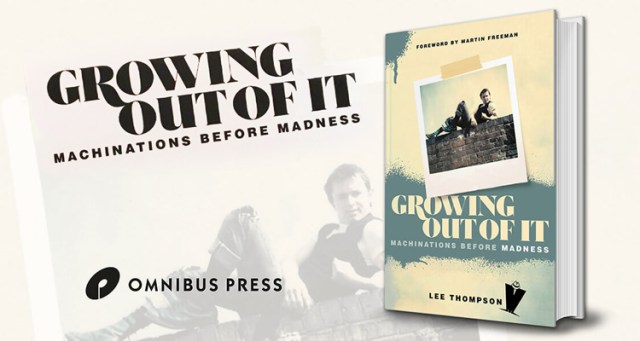
I got my copy of Lee Thompson’s memoir upon its release in April 2021, the limited edition autographed hardcover. Growing Out of It: Machinations Before Madness looks very smart alongside the other Madness and Suggs volumes on my bookshelf, where I must confess the book sat untouched for months. The timing of publication wasn’t ideal, certainly, coming right on the heels of the Before We Was We book and three-part documentary, then being swiftly overtaken by the flashback-fueled The Get Up! streaming extravaganza in May. Even a big fan like me felt a bit satiated with the spate of Madness nostalgia trips. What more could Lee fill a book with that we haven’t just run through several time already?
What finally got me to get into Growing Out of It was actually the September release of the audiobook edition (about which more later). These days I can get through any book faster by listening on my walks and in the car that I can by sitting down to flip pages. I can now report it’s a fine book indeed, with Lee sharing memories of his early life and how Madness started in ways that stand apart from the band’s recent mutual retrospectives.
In his introduction, Lee’s co-author Ian “Snowy” Snowball relates that the genesis of the book dates back to 2017, so I’m guessing this was in the works well before Before We Was We. I can imagine how chastened Snowy must have been to learn the band was putting together a coinciding book very much like his project with Thommo. The two autobiographies even share the same designated historical span, covering childhood through the first Madness recordings of 1979, and ending there. In the case of Growing Out of It, the stated concept is “only going up to the release of ‘The Prince’.”

Of course, this being of product of the unruly mind of Lee Thompson, the subject matter discussed is not so rigorously contained. Lee’s observations skip across the decades, occasionally mentioning the band’s later hits and fame, the Crunch days, the Madstock reunion, the Buckingham Palace gig, and a number of quite recent anecdotes. There’s one corker about Thommo just the other day confusing his reading glasses with a pair of Suggsy’s to the point of shouting, so we get a dash of old geezer comedy mixed in with this portrait of the artist as a young man.
Growing Out of It dutifully checks off the legends that have been told and retold since Take It or Leave It: Lee’s early life of petty crime, his fascination with old ska and rock steady records (mostly shoplifted), his saxophone with the serial number scratched out, not knowing how to tune a sax through their first album, the 2 Tone Tour, anti-authority hijinks at Top of the Pops, etc. Some of these old canards are fleshed out with new insights from Lee… if he is to be believed. Take the familiar tale of Thommo climbing in through the bathroom window to get into a Kilburn and the High Roads show, only to be confronted by Ian Dury himself. Here Lee claims there was actually no cover charge for entry that night, and he was only breaking in the back way out of habit. I mean, really? Another yarn I had a hard time swallowing was when Lee claims he once ran into Omar Sharif and did a Jake Blues “How much for your women?” routine – which sounds more like a showbiz gag Buddy Hackett would have told Johnny Carson than our lad Kix.
The odd potential fib aside, the book is loaded with choice morsels that were new to me, if indeed they’ve ever been shared heretofore. I howled at the story of Lee’s first time meeting Paul Weller, which involves a ritzy Los Angeles rock & roll party and the leader of The Jam going for a swim fully naked. Then there’s an indelicate summary of Chrissy Boy advising Lee of a peculiar home remedy for easing venereal disease pain, which leads to disastrous results. We get a full-on diatribe wherein Lee denounces the vile sartorial pestilence of white socks. “I just never like that look of white socks on display beneath a pair of Sta-Prest, or poking out from a nice pair of brogues or loafers,” Lee seethes. “It was so common at the end of the 1970s, but I detested it.”
Toward the end of the book, Lee drops a significant gem in the form of an old unfinished lyric he penned in the band’s formative days. “Jump in the Back of the Jag” has the makings of a cracking gangster ballad in the mold of “Drip Fed Fred” and “Herbert.” “Suggs knows it and keeps pushing me to complete it, so that Madness can record it,” Lee notes. “Maybe we’ll get around to finishing it one day.”
Lee speaks about his bandmates in turn, sharing his admiration and fondness for each of them at length. We fans tend to have the impression that Thommo’s biggest friends in Madness are Chris and Mike, since they are the original founding trio, and Lee has such a history of fruitful collaborations with those two. So it comes as some surprise when Lee reserves the warmest regards for Carl Smyth, since I’d heard the two of them didn’t always get along so well. Lee refutes rumors that he had been opposed to Carl becoming the seventh member of the band. “We idolised each other,” Lee confides. “He was my Clark Gable and I was his… well, Hilda Ogden.” (Google tells me Hilda was a character on the Coronation Street soap, who pretty much looked like Lee in drag in the “Our House” video.)
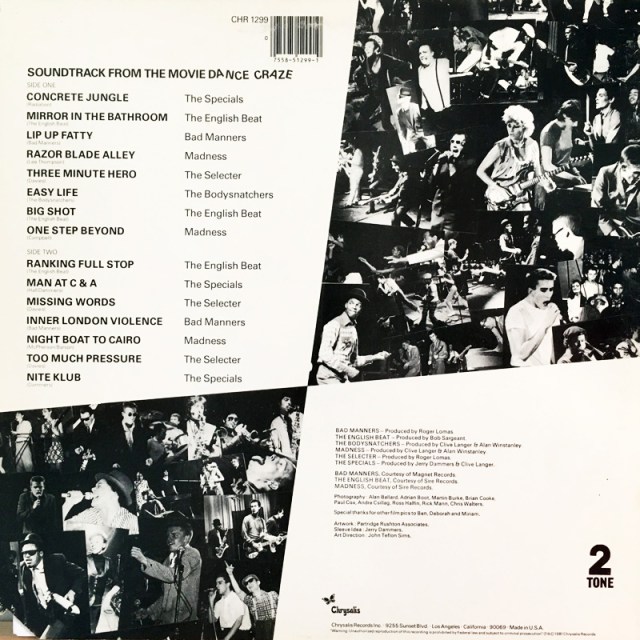
The book’s meandering narrative gathers a potent dramatic arc through its telling of the story of “The Prince.” I didn’t realize Lee expressly wrote the song for the purpose of being the band’s single for 2 Tone, since the band felt none of their small body of original tunes fit the aesthetic of Jerry Dammers’ label. Thommo rose to the challenge, listening to dozens of Prince Buster albums to craft a suitably ska-seeped tribute number. I love how Lee waxes poetic about holding that checkered 7-inch disc in his hands for the first time. Most artists are either too modest or too jaded to dwell on such moments of first accomplishment, but after the adversities Lee had gone through in his young life, he entirely earned that burst of pride. “Just having ‘The Prince’ committed to vinyl was enough,” Lee recalls. “It didn’t matter if it was a hit or not.”

The audiobook of Growing Out of It is not narrated by Lee, and celebrity memoirs not read by their familiar voices are typically a chore to sit through. Not so in the case. Although Matthew Lloyd Davies exhibits a posh BBC accent on his other audiobooks, here he puts on an extremely commendable Lee Thompson impression, capturing not only his North London accent but also his speech cadence, like the distinctive way Thommo draws out… his worrrds… to underscore a wry or bitter remark. Kudos to the audio producer who cast Davies, who makes this such an enjoyable listen. The only downside is when Davies reads the many footnotes and side comments from Lee’s wife Debbie, sister Tracy, Mike Barson, Chrissy Boy and other assorted friends. It can be difficult to know when the aside is finished and we’re back to Lee talking again.
That leaves just one observation about the book. Why does the autobiography of such a vibrant, colorful and creative individual have such a drab and boring title? Growing Out of It is weak sauce for a fellow who’s graced his works with titles like “March of the Gherkins” and The Benevolence of Sister Mary Ignatius. Given the heavy thematic focus on “The Prince,” I think the book should have taken its title drawn from those lyrics, like Shuffle Me Off My Feet, or Even If I Kept on Running. But then again, considering the sideways genius of Lee Thompson, Growing Out of It probably carries ironic layers of meaning that I won’t grasp until 15 years later.